Frozen Shoulder Treatment in Northbrook, IL


Is Your Shoulder Getting Stiffer? Don’t Wait Until You Can Barely Move It.
Frozen shoulder often begins with pain long before significant stiffness develops. Understanding what’s happening inside the shoulder joint can help you seek appropriate treatment before movement becomes severely restricted.
It may start with discomfort when reaching behind your back, putting on a jacket, or lifting your arm overhead.
Then the pain becomes more persistent.
Sleeping on the affected shoulder becomes difficult. Reaching into the back seat of your car hurts. Simple movements that once felt effortless become increasingly uncomfortable.
Over time, you may notice something more concerning: your shoulder isn’t just painful anymore.
It’s losing its ability to move.
This progression is characteristic of frozen shoulder, medically known as adhesive capsulitis.
Unlike ordinary muscle tightness, frozen shoulder involves changes within the shoulder joint capsule itself.
At Sports Acupuncturist in Northbrook, Illinois, we combine orthopedic assessment, manual muscle testing, motor point acupuncture, dry needling, and traditional acupuncture to address selected pain and muscle-function findings associated with shoulder conditions.
Our approach focuses on identifying the source of your symptoms, recognizing the stage of the condition, and selecting treatment appropriate to your examination findings.
What Is Frozen Shoulder?

Frozen shoulder, or adhesive capsulitis, is a condition characterized by progressive shoulder pain and restriction of movement.
The shoulder is a ball-and-socket joint surrounded by a connective tissue structure called the joint capsule.
Normally, this capsule allows the shoulder to move freely through a wide range of motion.
With adhesive capsulitis, inflammatory changes develop within the capsule.
Over time, the capsule can become thickened and fibrotic, reducing its flexibility and restricting movement.
This process can affect several shoulder movements, including:
- External rotation: Rotating the arm outward.
- Abduction: Lifting the arm away from the body.
- Flexion: Raising the arm forward or overhead.
- Internal rotation: Reaching behind the back.
One of the defining characteristics of frozen shoulder is that both active and passive shoulder movement become restricted.
This means the shoulder remains limited even when someone else attempts to move your relaxed arm.
That distinction is important because many other shoulder conditions primarily restrict movement due to pain or muscle weakness.
The Stages of Frozen Shoulder: When Is Treatment Most Helpful?
Frozen shoulder generally progresses through three overlapping stages: freezing, frozen, and thawing.
Some clinical models also recognize an earlier pre-adhesive stage, when pain is present but significant capsular restriction has not yet developed.
Understanding the stage helps determine which treatment strategies may be most appropriate.
Frozen Shoulder Stages and Treatment
| Stage & Duration | What’s Happening | Treatment Focus |
|---|---|---|
| 1. Early / Painful (0–3 months) | Capsular inflammation begins. Pain, especially at night, may develop before significant stiffness. | Early evaluation is especially valuable. Acupuncture around the affected shoulder may help manage pain. Maintain gentle, comfortable movement. |
| 2. Freezing (3–9 months) | Inflammation continues as the capsule thickens and shoulder mobility progressively decreases. | Important treatment window. Focus on pain relief, stage-appropriate mobility, and acupuncture directed toward the affected capsular region. |
| 3. Frozen (9–15 months) | Capsular fibrosis and contracture become more established. Pain may decrease, but movement is significantly restricted. | Not too late for treatment. Acupuncture may help manage pain, while progressive rehabilitation addresses established capsular stiffness. |
| 4. Thawing (12–24+ months) | Pain decreases and shoulder mobility gradually improves. | Support functional recovery through progressive mobility, strengthening, and treatment of associated muscular pain when present. |
Why Early Treatment Matters
During the early painful stage, inflammation is a prominent feature.
As frozen shoulder progresses, capsular thickening and fibrosis become more established.
This means the primary treatment objectives change over time.
Early stage: Identify the condition, manage pain, and maintain comfortable shoulder movement.
Freezing stage: Address increasing pain and stiffness while avoiding overly aggressive stretching.
Frozen stage: Manage persistent symptoms and progressively address established movement restrictions.
Thawing stage: Restore mobility, strength, and function as the shoulder gradually improves.
The frozen stage is not a point at which treatment becomes ineffective.
However, severe capsular restriction generally requires a different approach than the early inflammatory stage.
The earlier you understand what’s happening in your shoulder, the sooner you can begin appropriate management.
What Causes Frozen Shoulder?
The exact cause of primary frozen shoulder is not fully understood.
The condition involves an inflammatory and fibrotic process affecting the shoulder joint capsule.
Some cases develop without an obvious injury.
Others occur following shoulder immobilization, surgery, or another shoulder condition.
Several factors are associated with increased risk.
1. Diabetes
Frozen shoulder occurs more frequently in people with diabetes.
These patients may also experience more prolonged or severe shoulder stiffness.
2. Thyroid Disorders
Both hypothyroidism and hyperthyroidism have been associated with adhesive capsulitis.
3. Prolonged Shoulder Immobilization
Keeping the shoulder relatively immobile after surgery, fracture, or injury may contribute to secondary shoulder stiffness.
Movement should be resumed according to the treating clinician’s instructions.
4. Age and Sex
Frozen shoulder most commonly affects adults between approximately 40 and 60 years old and is more frequently diagnosed in women.
5. Previous Shoulder Conditions
Some patients develop shoulder stiffness following another injury or condition.
However, shoulder pain does not automatically progress to adhesive capsulitis.
Frozen shoulder is primarily a joint-capsule condition—not simply the result of weak rotator cuff muscles, poor posture, or tight shoulder muscles.
What Are the Early Signs of Frozen Shoulder?
The earliest symptoms can resemble more common shoulder problems.
Patients may initially notice:
- Pain when reaching overhead
- Discomfort when reaching behind the back
- Difficulty fastening a bra or putting on a jacket
- Pain when reaching into the back seat of a car
- Increasing night pain
- Difficulty sleeping on the affected shoulder
- Gradually decreasing shoulder mobility
As the condition progresses, shoulder movement becomes increasingly restricted.
External rotation is often particularly limited.
A Simple Observation: Can Someone Else Move Your Shoulder?
Consider two people who cannot lift their arms overhead.
One has rotator cuff pain and can move the arm farther when someone else assists.
The other has frozen shoulder and remains restricted even when the arm is moved passively.
The difference is clinically important.
In adhesive capsulitis, restriction of passive shoulder movement is a defining finding.
However, this observation alone cannot establish the diagnosis. A clinical examination is necessary to distinguish frozen shoulder from other causes of stiffness.
Frozen Shoulder vs. Rotator Cuff Injury: What’s the Difference?
Frozen shoulder is frequently confused with rotator cuff tendinopathy, rotator cuff tears, and other shoulder conditions.
| Feature | Frozen Shoulder | Rotator Cuff Injury |
|---|---|---|
| Primary structures involved | Shoulder joint capsule | Rotator cuff muscles and/or tendons |
| Typical onset | Often gradual | Gradual or sudden |
| Pain at night | Common | Also common |
| Active movement | Restricted | May be restricted by pain or weakness |
| Passive movement | Typically restricted | Often relatively preserved, unless another condition is present |
| External rotation | Frequently limited | May be painful or weak |
| Muscle weakness | May develop secondarily | May be a prominent finding |
| Primary treatment focus | Pain management, capsular mobility, functional recovery | Depends on tendon pathology, pain, strength, and function |
Some patients have more than one shoulder condition.
For example, a person may have rotator cuff pathology and develop secondary shoulder stiffness.
This is why orthopedic assessment is important before selecting treatment.
Why Frozen Shoulder Isn’t Just a Tight-Muscle Problem
When a shoulder becomes painful and restricted, it is tempting to assume that the surrounding muscles simply need to be loosened.
But adhesive capsulitis involves changes within the joint capsule.
Stretching the deltoid, massaging the rotator cuff, or releasing trigger points does not directly reverse capsular fibrosis.
Muscular pain and reduced muscle performance may develop alongside frozen shoulder, particularly when the patient begins avoiding shoulder movement.
However, these findings are not necessarily the primary cause of the restriction.
The distinction matters because treating muscular symptoms is different from treating established capsular stiffness.
At Sports Acupuncturist, we evaluate both joint mobility and relevant muscle function to determine which findings may be addressed through treatment.
How We Assess Frozen Shoulder at Sports Acupuncturist
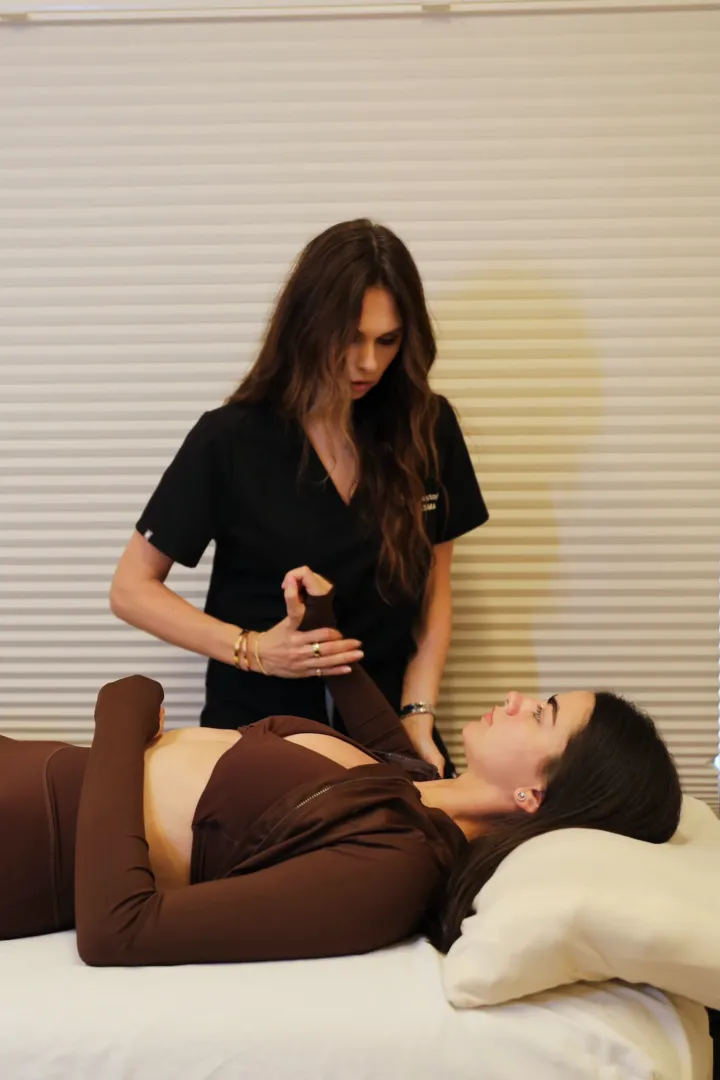
Our approach combines orthopedic assessment, manual muscle testing, and individualized treatment selection.
Step 1
Posture and Movement Assessment
We begin by discussing your symptoms and evaluating relevant shoulder movement.
Depending on the presentation, this may include:
- Shoulder flexion
- Shoulder abduction
- External rotation
- Internal rotation
- Scapular movement
- Cervical mobility
- Thoracic mobility
We also discuss when symptoms began, whether they are worsening, and how they affect daily activities.
Step 2
Orthopedic Testing
Orthopedic assessment helps distinguish adhesive capsulitis from other shoulder conditions.
Active Range-of-Motion Testing
We evaluate how far you can move the shoulder independently.
Passive Range-of-Motion Testing
We assess shoulder movement when the arm is moved without active muscular effort.
Restriction of both active and passive movement is particularly important when evaluating possible adhesive capsulitis.
Rotator Cuff Testing
Selected orthopedic tests may help identify associated rotator cuff pathology.
Cervical Assessment
When symptoms suggest referred pain, the neck may also be evaluated.
Trigger Point Assessment
We assess relevant shoulder and surrounding muscles for identifiable trigger points that reproduce familiar pain.
When findings suggest adhesive capsulitis, medical evaluation may be recommended to confirm the diagnosis and consider appropriate treatment options.
Step 3
Manual Muscle Testing
Depending on the patient’s symptoms and available range of motion, we may assess:
- Supraspinatus
- Infraspinatus
- Subscapularis
- Deltoid
- Selected scapular stabilizers
Manual muscle testing helps identify relevant muscle-performance findings.
However, testing is adapted to the patient’s available movement and pain level.
A muscle may appear weak because pain or joint restriction limits the test—not necessarily because the muscle itself is dysfunctional.
This distinction is particularly important in frozen shoulder.
Step 4
Individualized Needling Treatment
Treatment is selected according to the examination findings and stage of the condition.
We may incorporate:
Local Acupuncture: Anatomically guided treatment directed toward regions surrounding the affected shoulder joint capsule.
Motor Point Acupuncture: To address selected muscle-performance findings.
Dry Needling: To release identifiable myofascial trigger points associated with familiar pain.
Traditional and Distal Acupuncture: To help manage pain through additional selected acupuncture points.
Treatment is adapted to the patient’s symptoms and shoulder irritability.
Step 5
Reassessment
Following treatment, we may repeat selected muscle tests or shoulder movements.
This allows us to observe short-term changes in pain, movement, or muscle performance.
Reassessment helps guide subsequent treatment decisions.
How Sports Acupuncture May Help Frozen Shoulder
Frozen shoulder is different from many other shoulder conditions because the primary problem involves the glenohumeral joint capsule—the connective tissue surrounding the shoulder joint.
As adhesive capsulitis progresses, inflammation, capsular thickening, and fibrosis can restrict shoulder movement.
This is why our treatment approach considers the joint capsule itself rather than focusing exclusively on the surrounding muscles.

Local Acupuncture: Targeting the Capsular Region
At Sports Acupuncturist, local acupuncture may be directed toward anatomical regions surrounding the affected shoulder joint capsule.
Needle stimulation can influence local sensory signaling and microcirculation, potentially contributing to pain relief and changes in the local tissue environment.
The objective is to address pain associated with the affected region while supporting comfortable shoulder movement.
Although these physiological effects are relevant to acupuncture, research has not established that acupuncture reverses capsular fibrosis or directly accelerates healing of the shoulder capsule.
Motor Point Acupuncture: Addressing Muscle Function
Frozen shoulder can also affect the performance of surrounding muscles.
Pain and restricted movement may influence the rotator cuff, deltoid, and scapular stabilizers.
When manual muscle testing identifies relevant muscle-performance findings, motor point acupuncture may be incorporated to address these findings.
Depending on the assessment, treatment may involve selected rotator cuff or shoulder muscles.
Following treatment, muscle performance may be reassessed.
However, improving a manual muscle test does not establish that capsular fibrosis has resolved.
Dry Needling: Releasing Trigger Points
Some patients with frozen shoulder also develop myofascial trigger points in the surrounding shoulder muscles.
When examination identifies a trigger point that reproduces the patient’s familiar pain, dry needling may be used to help release it.
This can address associated muscular pain, although it does not directly reverse the underlying capsular restriction.
Not every painful shoulder muscle contains a trigger point.
This is why dry needling is selected according to the examination findings rather than applied automatically.
Traditional and Distal Acupuncture: Supporting Pain Relief
Traditional acupuncture may also be used at distal points to help manage shoulder pain.
Needle stimulation can influence sensory signaling and pain processing.
These responses may contribute to symptom relief.
The selection of points depends on the patient’s symptoms and treatment objectives.
Why Treatment Changes With Each Stage
During the early painful and freezing stages, treatment emphasizes pain management and maintaining comfortable movement.
During the frozen stage, established capsular stiffness becomes the primary functional limitation.
Acupuncture may continue to address pain, while progressive mobility treatment becomes increasingly important.
During the thawing stage, treatment focuses on restoring function and addressing any remaining muscular limitations.
The key is recognizing that frozen shoulder involves the joint capsule—not simply tight muscles—and selecting treatment according to the stage of the condition.
Is It Too Late to Treat Frozen Shoulder Once It Reaches the Frozen Stage?
No. The frozen stage is not too late for treatment.
However, treatment priorities change as the condition progresses.
During the freezing stage, pain and inflammation are often prominent.
During the frozen stage, stiffness becomes the dominant limitation.
At this point, the shoulder capsule may have developed substantial fibrosis and contracture.
Needling the surrounding muscles cannot mechanically reverse this structural restriction.
However, patients may still benefit from appropriate pain management, medical treatment, and progressive rehabilitation.
What Treatment Looks Like During the Frozen Stage
Treatment may focus on:
- Managing persistent shoulder discomfort
- Maintaining available movement
- Addressing associated muscular pain
- Progressively restoring mobility as tolerated
- Improving function during daily activities
- Coordinating with physical therapy or orthopedic care when appropriate
For patients with persistent severe stiffness, medical options such as hydrodilatation, manipulation under anesthesia, or arthroscopic capsular release may be considered by an orthopedic specialist.
These procedures are not necessary for every patient.
Why Earlier Evaluation Is Preferable
Earlier evaluation may help identify adhesive capsulitis before substantial movement restriction develops.
It also provides an opportunity to discuss treatments that may be particularly useful during the painful inflammatory phase.
For example, intra-articular corticosteroid injections can provide short-term pain and functional benefits in appropriately selected patients, particularly earlier in the condition.
However, no treatment has been conclusively shown to prevent every case from progressing through the typical stages.
The goal of early care is appropriate diagnosis and symptom management—not a guarantee that the shoulder will never freeze.
How Long Does Frozen Shoulder Take to Heal?
Frozen shoulder often follows a prolonged course.
Many patients experience symptoms for one to three years.
Some improve sooner, while others experience persistent stiffness or incomplete recovery.
Recovery depends on several factors, including:
- Severity of capsular restriction
- Duration of symptoms
- Diabetes or other associated conditions
- Previous shoulder injury or surgery
- Response to treatment
- Ability to participate in appropriate rehabilitation
The reduction of pain does not always mean the condition has fully resolved.
During the frozen stage, pain may improve while substantial stiffness remains.
Similarly, the thawing stage may involve gradual improvement over many months.
What Treatments Are Available for Frozen Shoulder?
Treatment is generally individualized according to the severity and stage of the condition.
Physical Therapy
Physical therapy can help maintain and progressively restore shoulder mobility.
Treatment intensity should reflect the patient’s symptoms and stage.
Aggressive stretching during a highly painful phase may worsen symptoms.
As irritability decreases, mobility and strengthening exercises can be progressed.
Corticosteroid Injections
Intra-articular corticosteroid injections may help reduce pain and improve function, particularly during the early painful stages.
These injections are performed by appropriately licensed medical professionals.
Hydrodilatation
Hydrodilatation involves injecting fluid into the shoulder joint to expand the capsule.
It may be considered for selected patients with persistent restriction.
Sports Acupuncture
Sports acupuncture may be incorporated alongside medical care and rehabilitation to address selected pain and muscle-performance findings.
Treatment may include local acupuncture directed toward the affected capsular region, motor point acupuncture, dry needling, or traditional acupuncture depending on the examination.
Surgical Treatment
Surgery is generally reserved for selected patients with persistent, significant limitations despite appropriate nonsurgical management.
Procedures may include arthroscopic capsular release.
Can Frozen Shoulder Be Prevented?
Not every case of frozen shoulder can be prevented.
Primary adhesive capsulitis may develop without a clear cause.
However, several strategies may help reduce avoidable shoulder stiffness or support early management.
1. Avoid Unnecessary Prolonged Immobilization
Following an injury or surgery, shoulder movement should be resumed according to the treating clinician’s instructions.
Prolonged immobilization can contribute to secondary stiffness.
2. Recognize Progressive Loss of Motion
Persistent shoulder pain accompanied by gradually decreasing mobility deserves evaluation.
This is especially important when external rotation becomes increasingly restricted.
3. Manage Associated Medical Conditions
Diabetes and thyroid disorders are associated with frozen shoulder.
Appropriate medical management is important for overall health, although it cannot guarantee prevention.
4. Avoid Forcing Painful Movement
Aggressive stretching during the highly painful stages may aggravate symptoms.
Movement should be appropriate to the stage and irritability of the condition.
5. Seek Assessment Before Severe Restriction Develops
Early evaluation can help distinguish frozen shoulder from rotator cuff injuries, arthritis, and other shoulder conditions.
This allows an appropriate treatment strategy to begin sooner.
What Does Research Say About Frozen Shoulder?
Research supports the importance of identifying adhesive capsulitis and tailoring treatment to the patient’s symptoms and clinical stage.
Early Diagnosis and Treatment
A 2024 study published in Journal of Ultrasound examined the importance of early diagnosis and treatment in adhesive capsulitis.
The research evaluated hydrodilatation combined with physical therapy in patients at different stages of the condition.
The findings support continued investigation into how treatment timing may influence outcomes.
Physical Therapy and Corticosteroid Injections
Clinical reviews have found that physical therapy and intra-articular corticosteroid injections can provide benefits for selected patients.
Corticosteroid injections may be particularly helpful for short-term pain relief during the painful stages.
Acupuncture and Frozen Shoulder
Acupuncture has been investigated as a treatment for adhesive capsulitis and other shoulder pain conditions.
Research suggests that some patients may experience improvements in pain or shoulder function.
At Sports Acupuncturist, treatment is selected according to the patient’s examination findings, symptoms, and stage of recovery.
What to Expect
01
Assessment
A detailed look at how your body moves, identifying restrictions, imbalances, and overload.
02
Understanding the Cause
We connect your symptoms to how your body is functioning – not just where it hurts.
03
Targeted Treatment
A combination of acupuncture, dry needling, and motor point work based on your needs.
04
Ongoing Progress
Treatment evolves as your body adapts, focusing on long-term results and better movement.
Frozen Shoulder Treatment in Northbrook and Chicago’s North Shore

If your shoulder pain is becoming more persistent—or you’re noticing that everyday movements are becoming increasingly restricted—understanding the source of your symptoms is an important first step.
Frozen shoulder is not simply a tight-muscle problem.
It involves changes within the shoulder joint capsule, and treatment priorities change as the condition progresses.
At Sports Acupuncturist, we combine orthopedic assessment, manual muscle testing, local acupuncture directed toward the affected capsular region, motor point acupuncture, dry needling, and traditional acupuncture to develop individualized treatment strategies for musculoskeletal pain.
We serve patients from Northbrook, Deerfield, Bannockburn, Highland Park, Glenview, Northfield, and surrounding North Shore communities.
The sooner you understand why your shoulder is losing movement, the sooner you can begin appropriate care.
Our Address
Sports Acupuncturist1535 Lake Cook Rd, Suite 405
Northbrook, IL 60062
Hours
By appointment only
Ready to find out what’s contributing to your pain?
Schedule an appointment for an individualized musculoskeletal assessment and treatment plan.
Initial Consultation + Treatment
45-60 minutes
A comprehensive evaluation, movement assessment, and your first treatment.
1535 Lake Cook Rd, Suite 405
Northbrook, IL 60062
By appointment only
Frequently Asked Questions About Frozen Shoulder
What are the first signs of frozen shoulder?
Early symptoms often include shoulder pain, night discomfort, and difficulty reaching overhead or behind the back.
As the condition progresses, shoulder movement becomes increasingly restricted.
What are the three stages of frozen shoulder?
The three commonly recognized stages are freezing, frozen, and thawing.
Some clinical models also recognize an earlier pre-adhesive stage.
Each stage is associated with different patterns of pain, inflammation, and stiffness.
When is the best time to treat frozen shoulder?
Early evaluation is preferable, particularly when shoulder pain is accompanied by progressive loss of movement.
Treatment can begin during any stage, but the approach should reflect the condition’s severity and irritability.
Is it too late to treat frozen shoulder during the frozen stage?
No.
Although substantial capsular stiffness may already be present, appropriate treatment and rehabilitation can still help address pain, mobility, and function.
The frozen stage is not a point beyond which treatment becomes ineffective.
Can acupuncture help frozen shoulder?
Sports acupuncture may be incorporated into an individualized treatment plan to help manage pain and address selected muscular findings.
Local acupuncture may be directed toward the affected capsular region, while other techniques are selected according to the examination findings.
Can dry needling release frozen shoulder?
Dry needling does not directly release a contracted shoulder joint capsule.
In our practice, dry needling is used to release identified myofascial trigger points that reproduce familiar pain.
These muscular findings may coexist with frozen shoulder.
Can motor point acupuncture restore shoulder strength?
Motor point acupuncture may be used when manual muscle testing identifies reduced muscle performance.
However, strength testing can be influenced by pain and restricted joint movement.
Changes in testing do not necessarily indicate that the underlying capsular restriction has resolved.
Why does frozen shoulder hurt more at night?
Night pain is common during the early inflammatory stages of adhesive capsulitis.
Pain may become more noticeable at rest or when lying on the affected shoulder.
The precise mechanisms vary and are not fully understood.
Does frozen shoulder go away on its own?
Many patients gradually improve over time.
However, recovery can take one to three years, and some people experience persistent stiffness or incomplete restoration of motion.
Can frozen shoulder affect both shoulders?
Yes.
Some patients develop adhesive capsulitis in the opposite shoulder at a different time.
Simultaneous involvement of both shoulders is less common.
Is frozen shoulder more common in women?
Yes.
Frozen shoulder is more frequently diagnosed in women, particularly during middle age.
Is frozen shoulder related to menopause?
Frozen shoulder is common during the age range when many women experience perimenopause or menopause.
Hormonal factors have been proposed as possible contributors, but a direct causal relationship has not been established.
Should I stretch a frozen shoulder?
Gentle, stage-appropriate mobility exercises may be helpful.
However, aggressive stretching during a highly painful stage may aggravate symptoms.
Exercise intensity should be guided by the patient’s condition and response.
How long does frozen shoulder last?
Frozen shoulder commonly lasts one to three years, although individual recovery times vary.
Some patients regain movement sooner, while others experience prolonged stiffness.
Can sports acupuncture be combined with physical therapy?
Yes.
Physical therapy can address joint mobility, strengthening, and functional recovery.
Sports acupuncture may be incorporated alongside rehabilitation to address selected pain and muscle-performance findings.
Scientific References
- Vita F, et al. Adhesive Capsulitis: The Importance of Early Diagnosis and Treatment. Journal of Ultrasound. 2024.
- Ben-Arie E, et al. The Effectiveness of Acupuncture in the Treatment of Frozen Shoulder: A Systematic Review and Meta-analysis. 2020.
- Clinical Practice Guidelines for Diagnosis and Non-Surgical Treatment of Primary Frozen Shoulder. 2025.

About the Author
Dr. Lijana Shestopal, DTCM, L.Ac.
Dr. Lijana Shestopal is an Illinois-licensed acupuncturist specializing in sports acupuncture, orthopedic conditions, and musculoskeletal pain.
She earned her master’s degree in Acupuncture and Herbal Medicine from the Midwest College of Oriental Medicine and subsequently completed her Doctor of Traditional Chinese Medicine (DTCM) degree at Five Branches University.
She holds national board certification as a Diplomate of Acupuncture and Herbal Medicine (NCBAHM) and has completed extensive advanced training in orthopedic and sports acupuncture, including musculoskeletal assessment, manual muscle testing, motor point acupuncture, and dry needling.
Her clinical approach integrates traditional acupuncture with modern anatomical and orthopedic assessment techniques to address pain, muscle dysfunction, and movement-related conditions.