Hip Pain Treatment in Northbrook, IL


Does your hip hurt when walking, running, climbing stairs or getting out of a chair? Do you experience pain when sleeping on your side, tightness in the front of your hips or deep discomfort in your buttocks?
Hip pain can develop from muscular imbalances, tendon irritation, joint problems, prolonged sitting and changes in how your pelvis and surrounding muscles function.
While stretching the hips is often recommended, not every painful or tight hip needs more flexibility. Sometimes the problem is a lack of muscular support, strength or stability.
At Sports Acupuncturist in Northbrook, Illinois, we combine orthopedic testing, manual muscle testing, postural and movement assessment, motor point acupuncture and trigger point dry needling to address hip pain and its potentially contributing factors.
Understanding why your hip hurts is the first step toward determining how it should be treated.
Common Hip Pain Symptoms and Conditions We Address
- Pain on the outside of the hip
- Pain in the front of the hip or groin
- Deep buttock pain
- Hip pain when sleeping on your side
- Hip pain when walking or running
- Hip pain after prolonged sitting
- Tight hip flexors
- Hip stiffness and restricted movement
- Hip bursitis
- Gluteal tendinopathy
- Greater trochanteric pain syndrome (GTPS)
- Piriformis-related pain
- Snapping hip syndrome
- Muscular symptoms associated with hip impingement
- Hip osteoarthritis
- Sports-related hip pain
What Does the Location of Your Hip Pain Tell You?
The hip is surrounded by numerous muscles, tendons, ligaments and nerves. Where you experience pain can provide valuable information about which structures may be involved.
| Location of Hip Pain | Possible Contributing Factors |
|---|---|
| Outside of the hip | Gluteal tendon irritation, hip bursitis or muscular overload. |
| Front of the hip | Hip flexor irritation, muscular tension or hip joint problems. |
| Groin | Hip joint irritation, hip impingement or inner thigh muscle injuries. |
| Deep in the buttock | Gluteal muscles, piriformis-related pain or referred pain from the lower back. |
| Back of the hip near the pelvis | Sacroiliac joint irritation, lower back dysfunction or muscular imbalance. |
| Pain traveling down the leg | Potential nerve irritation or referred pain from the lower back or surrounding tissues. |
Pain location is only one piece of the puzzle. Different conditions can produce similar symptoms, which is why orthopedic testing and movement assessment are important.
Why Does the Outside of My Hip Hurt?
Pain on the outside of the hip is a common complaint, particularly among runners, active adults and people who experience discomfort when sleeping on their side.
This condition is frequently referred to as hip bursitis. However, research has shown that irritation of the gluteal tendons is often involved as well.
The broader term for this condition is greater trochanteric pain syndrome (GTPS).
Common symptoms include:
- Pain when lying on the affected side
- Tenderness over the bony area on the outside of the hip
- Pain when climbing stairs
- Discomfort during prolonged walking
- Pain when standing on one leg
- Pain when crossing your legs
- Hip discomfort during or after running
The gluteus medius and gluteus minimus are muscles located on the side of your hip. Their job is to help stabilize your pelvis and control your leg during movement.
When these muscles or their tendons cannot adequately tolerate the demands placed on them, the surrounding area may become painful.
In these cases, aggressive stretching across the body may actually increase compression on the irritated tendons and aggravate symptoms.
Treatment may need to focus on reducing pain, modifying daily activities and gradually improving the strength and load tolerance of the gluteal muscles.
Why Do My Hip Flexors Always Feel Tight?
Hip flexors are the muscles at the front of your hip that help you lift your leg, climb stairs, run and bend at the waist.
Many people spend eight or more hours sitting at work, followed by additional time driving or sitting at home.
This means the hips often spend a large portion of the day in a bent position, with relatively few opportunities to move through their full range.
Over time, this may contribute to changes in hip mobility, muscular endurance and movement habits.
However, constantly stretching your hip flexors may not resolve the problem if other factors are involved.
Hip flexors may feel tight because they are:
- Physically shortened
- Overworked
- Compensating for other muscles
- Experiencing pain-related tension
- Fatigued from repetitive activities
- Working harder because of insufficient pelvic stability
For example, if the glutes are not contributing effectively during certain movements, other muscles around the hip may have to take on additional work.
A tight muscle is not always a short muscle. Sometimes it is simply a muscle doing more work than it should.
How Pelvic Position Can Contribute to Hip Pain
The position of your pelvis influences the resting length of many muscles surrounding your hips, lower back and thighs.
This is why assessing pelvic positioning can be valuable when determining whether a muscle needs stretching, activation or strengthening.
Anterior Pelvic Tilt
Anterior pelvic tilt occurs when the pelvis tilts forward.
This position may be accompanied by an increased curve in the lower back and changes in the resting position of the hip flexors, glutes and hamstrings.
Some muscles at the front of the hip may be held in a relatively shortened position, while certain muscles at the back of the hip and thigh may be held in a relatively lengthened position.
These muscles may still feel tight, even when they are already lengthened.
Repeatedly stretching an already lengthened and overloaded muscle may not address the reason it feels tight.
Posterior Pelvic Tilt
Posterior pelvic tilt occurs when the pelvis tilts backward, often reducing the natural curve of the lower back.
This changes the resting position of the muscles around the hips and may influence how they contribute to movement.
Some muscles may benefit from improved mobility, while others may require improved strength or activation.
Uneven Pelvic Positioning
Sometimes one side of the pelvis sits higher than the other or moves differently during walking, running or standing on one leg.
This may change how forces are distributed between the two hips and create additional demands on certain muscles.
Pelvic positioning alone does not mean something is wrong. Many people have natural postural variations without experiencing pain.
The important question is whether your posture, muscular function and movement patterns are contributing to your symptoms.
The Role of Your Glutes in Hip Pain
Your glutes do much more than provide power during exercise. They help support your pelvis, control your legs and distribute forces throughout your lower body.
Three muscles play particularly important roles.
| Muscle | What It Does |
|---|---|
| Gluteus maximus | Your largest glute muscle. Helps extend the hip during walking, running, climbing stairs and standing up. |
| Gluteus medius | Located on the side of the hip. Helps keep your pelvis stable when standing or moving on one leg. |
| Gluteus minimus | A smaller, deeper glute muscle that contributes to hip stability and movement control. |
Every time you take a step, your body briefly relies on one leg for support.
If your glutes are not providing adequate support, other muscles around the hip, pelvis and lower back may compensate.
This can contribute to recurring tension in areas such as the hip flexors, piriformis, outer thigh and lower back.
For example, a patient experiencing pain on the outside of the hip may have both irritated gluteal tendons and difficulty activating certain glute muscles.
Simply releasing every tender muscle may not be the most appropriate solution.
Muscle testing helps us determine how well selected muscles are functioning and whether treatment should focus on reducing tension, improving activation or a combination of both.
How Hip Pain Can Affect Your Lower Back and Knees
Your hip is an important connection between your upper and lower body.
When the hip is not moving or functioning effectively, other areas may compensate.
| Area Affected | How the Hip May Contribute |
|---|---|
| Lower back | The lower back may compensate when the hips have restricted movement or insufficient muscular support. |
| Knee | Reduced hip control may influence how the thigh and knee move during walking, stairs and exercise. |
| Pelvis | Altered glute function may affect pelvic stability during movement. |
| IT band | Changes in hip muscle function may influence tension and loading along the outside of the thigh. |
| Hamstrings | May take on additional work when other hip muscles are not contributing effectively. |
This is why treating hip pain sometimes requires assessing the lower back, knees, ankles and overall movement patterns.
Similarly, recurring lower back or knee pain may warrant an assessment of hip function.
Is Your Hip Too Tight or Not Stable Enough?
Many people experiencing hip stiffness assume they need to become more flexible.
However, additional flexibility is not always what the body needs.
Sometimes the hip has sufficient range of motion, but the muscles are having difficulty controlling that movement.
| Type of Problem | What It Means |
|---|---|
| Mobility | Your hip may not have enough freedom of movement. |
| Stability | Your muscles may have difficulty supporting and controlling the hip. |
| Muscle activation | Certain muscles may not be contributing effectively when needed. |
| Strength and endurance | Your muscles may not have the capacity to tolerate repeated daily or athletic demands. |
For example, someone may experience tightness in the front of the hip despite having adequate flexibility.
If the surrounding muscles are not providing sufficient stability, repeatedly stretching the hip may not address the underlying problem.
Determining whether your hip needs more mobility, stability or strength helps guide both treatment and corrective exercises.
Hip Bursitis, Gluteal Tendinopathy, Hip Impingement or Piriformis Syndrome?
Several different conditions can produce hip pain.
| Condition | Common Symptoms |
|---|---|
| Hip bursitis | Tenderness and pain on the outside of the hip, often aggravated by direct pressure. |
| Gluteal tendinopathy | Outer hip pain during walking, stairs, running or lying on your side. |
| Hip impingement (FAI) | Deep hip or groin discomfort during squatting, sitting or bringing the knee toward the chest. |
| Hip flexor irritation | Pain or discomfort at the front of the hip when lifting the leg or performing certain movements. |
| Piriformis-related pain | Deep buttock discomfort, sometimes accompanied by symptoms traveling down the leg. |
| Hip osteoarthritis | Joint stiffness, groin pain and difficulty with certain everyday movements. |
| Hip labral injury | Deep joint or groin pain, sometimes accompanied by catching or clicking. |
These symptoms can overlap, and a single physical test does not necessarily establish which condition is present.
Orthopedic assessment helps identify potentially involved structures and determine whether imaging or further medical evaluation may be appropriate.
How We Assess and Treat Hip Pain
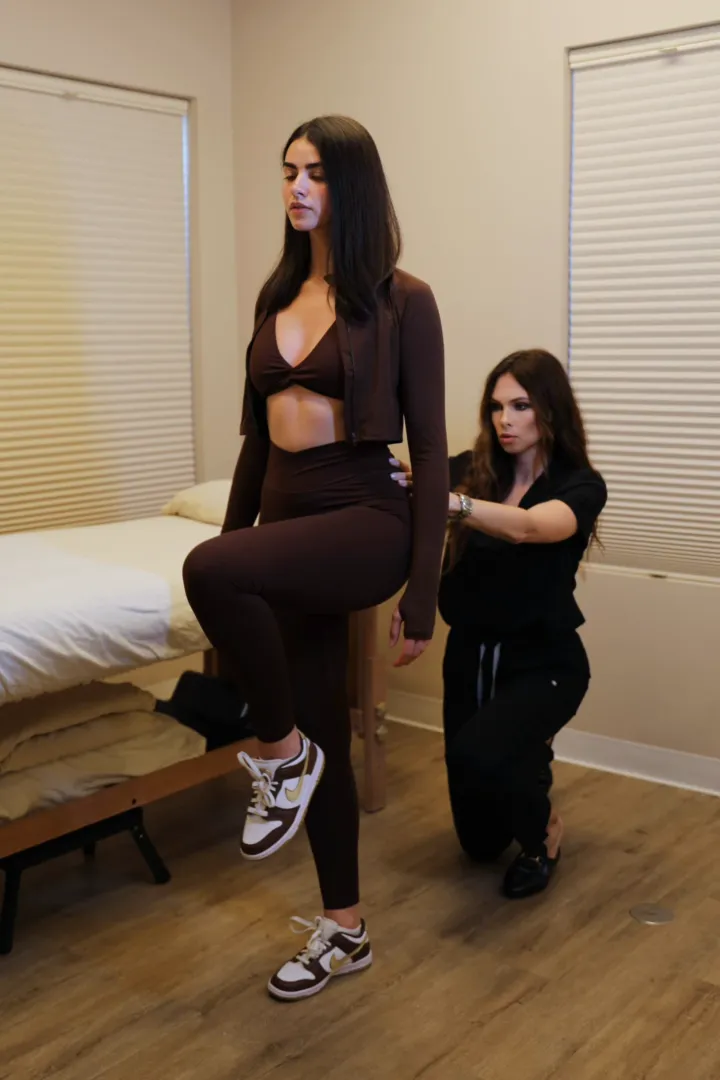
At Sports Acupuncturist, treatment is based on your individual assessment rather than a standard set of acupuncture points for hip pain.
1
Postural Assessment
We evaluate the position of your pelvis, lower back, hips, knees and feet.
This helps us understand how your posture may influence muscular tension and the distribution of forces throughout your lower body.
2
Orthopedic Testing
Specific physical tests help us evaluate whether your discomfort may involve the hip joint, tendons, muscles, surrounding nerves or other structures.
We also assess whether the pain may be originating from your lower back rather than the hip itself.
3
Manual Muscle Testing
We test selected muscles to evaluate how well they can produce and maintain force.
Depending on your symptoms, this may include the glutes, hip flexors, hamstrings, inner thigh muscles and other muscles supporting the pelvis.
This helps identify potentially underperforming muscles and compensatory movement patterns.
4
Functional Movement Assessment
We may evaluate movements such as walking, squatting, bending, standing on one leg and moving the hip through different positions.
This helps determine whether limitations are related to mobility, muscular support or difficulty controlling movement.
5
Individualized Treatment and Reassessment
Based on our findings, we select the appropriate needling techniques.
Following treatment, relevant muscle tests and movements may be reassessed to evaluate your response and guide subsequent care.
How Sports Acupuncture Helps With Hip Pain
Sports acupuncture combines three complementary needling techniques.
| Treatment | What It May Help You Achieve |
|---|---|
| Motor point acupuncture | Improve the activation of muscles that may not be working effectively, including the glutes and other muscles supporting the hip. |
| Trigger point dry needling | Reduce painful muscular tension, knots and areas of tenderness. |
| Acupuncture | Reduce pain, influence local circulation and help regulate pain signals within the nervous system. |
For example, a patient with persistent hip flexor tension may also demonstrate reduced glute function.
Rather than simply needling the tight hip flexors, treatment may incorporate motor point acupuncture to address altered glute activation.
Another patient experiencing pain when sleeping on their side may require a different approach focused on managing gluteal tendon irritation and associated muscular discomfort.
Two patients with hip pain may need completely different treatments depending on what is contributing to their symptoms.
Why Corrective Exercises Are Important for Hip Pain
Acupuncture and dry needling may help address pain and muscular dysfunction, but longer-term improvement often requires developing the body’s ability to tolerate everyday activities.
This is especially important for people who spend long hours sitting, runners who repeatedly load their hips and individuals experiencing recurring muscular imbalances.
Depending on your individual needs, corrective exercises and rehabilitation may focus on:
| Exercise Focus | Purpose |
|---|---|
| Glute strengthening | Improve hip support, strength and pelvic stability. |
| Hip mobility exercises | Improve movement where genuine restrictions exist. |
| Single-leg stability exercises | Improve control during walking, running and climbing stairs. |
| Core strengthening | Improve support and coordination between the pelvis and trunk. |
| Progressive tendon-loading exercises | Improve the ability of irritated tendons to tolerate physical activity. |
| Movement retraining | Address compensatory movement patterns that may contribute to pain. |
Not everyone with hip pain needs to stretch their hip flexors, and not everyone needs additional glute strengthening.
Exercises should be selected according to the individual’s assessment findings.
Sports acupuncture can complement physical therapy and exercise-based rehabilitation by helping address pain, excessive muscular tension and altered muscular activation.
How to Reduce Hip Pain From Sitting All Day
If your work requires prolonged sitting, small changes in your daily habits may help reduce recurring hip discomfort.
- Take brief walking or movement breaks every 30–60 minutes.
- Alternate between sitting and standing when possible.
- Avoid remaining in the same position for several hours.
- Incorporate regular lower-body strength training.
- Perform mobility exercises that address your specific restrictions.
- Avoid repeatedly stretching muscles simply because they feel tight.
- Gradually increase your physical activity rather than making sudden changes.
If you experience pain on the outside of your hip, avoiding prolonged leg crossing or sleeping directly on the painful side may also help reduce irritation.
Placing a pillow between your knees when sleeping on the opposite side may reduce pressure on sensitive outer hip tendons.
The goal is not to maintain perfect posture throughout the day but to improve movement variety, muscular function and tolerance to daily activities.
Can Acupuncture Help With Hip Arthritis?
Hip osteoarthritis involves changes within the joint, including the cartilage and surrounding structures.
However, arthritis visible on an X-ray does not always correspond directly with the amount of pain someone experiences.
Muscular strength, joint mobility, activity levels and pain sensitivity can also influence symptoms.
Acupuncture may help manage arthritis-related pain in some individuals, although research specifically examining hip osteoarthritis has produced mixed results.
Motor point acupuncture may be considered when reduced muscle activation is present, while dry needling may help address associated muscular discomfort.
Acupuncture does not regenerate lost cartilage or reverse osteoarthritis.
Treatment focuses on managing symptoms, supporting muscular function and improving tolerance to everyday activities.
Appropriate exercise remains an important component of hip arthritis management.
Does Acupuncture Really Work for Hip Pain?
Research supports acupuncture as a treatment option for several chronic musculoskeletal pain conditions.
A large 2018 analysis involving more than 20,000 patients found that acupuncture provided greater benefits for the chronic pain conditions studied than sham acupuncture or no-acupuncture controls.
A randomized clinical trial published in the Journal of Manual & Manipulative Therapy in 2017 found that dry needling was not inferior to cortisone injections for greater trochanteric pain syndrome over a six-week follow-up period.
Research published in the British Medical Journal in 2018 also demonstrated the importance of exercise and education about managing daily physical demands for patients with gluteal tendinopathy.
Individual components of sports acupuncture have been studied and demonstrated positive outcomes in different areas of musculoskeletal care.
Combining these techniques with individualized assessment and appropriate rehabilitation allows treatment to address several factors potentially contributing to hip pain.
Sports Acupuncture vs. Physical Therapy, Chiropractic Care and Massage for Hip Pain
| Discipline | What It Can Help You Achieve |
|---|---|
| Sports acupuncture | Reduce pain and muscular tension while addressing altered muscle activation and muscular imbalances. |
| Physical therapy | Improve hip strength, stability, mobility and tolerance to physical activity through rehabilitation. |
| Chiropractic care | Address certain joint-related movement restrictions and musculoskeletal discomfort. |
| Massage therapy | Reduce muscular tension and soft tissue discomfort. |
These approaches can complement one another.
For example, sports acupuncture may help reduce pain and improve glute activation, while physical therapy helps develop the strength, stability and endurance necessary for longer-term improvement.
What to Expect
01
Assessment
A detailed look at how your body moves, identifying restrictions, imbalances, and overload.
02
Understanding the Cause
We connect your symptoms to how your body is functioning – not just where it hurts.
03
Targeted Treatment
A combination of acupuncture, dry needling, and motor point work based on your needs.
04
Ongoing Progress
Treatment evolves as your body adapts, focusing on long-term results and better movement.
Hip Pain Treatment in Northbrook, Illinois
At Sports Acupuncturist, Dr. Lijana Shestopal, DTCM, L.Ac., specializes in sports injuries, orthopedic conditions and musculoskeletal pain.
By combining postural assessment, orthopedic testing, manual muscle testing, motor point acupuncture and trigger point dry needling, we take an individualized approach to understanding why your hip pain may have developed and why it may keep returning.
Whether you experience hip pain from prolonged sitting, running, exercise, sleeping on your side or everyday activities, treatment is tailored to your individual clinical findings.
We serve Northbrook, Deerfield, Bannockburn, Highland Park, Lake Forest, Glenview and surrounding Chicago North Shore communities.
Initial Consultation + Treatment: 45–60 minutes
Our Address
Sports Acupuncturist1535 Lake Cook Rd, Suite 405
Northbrook, IL 60062
Hours
By appointment only
Before stretching your tight hips again, find out whether they actually need more flexibility or better muscular support.
Schedule your initial consultation and treatment today.
Initial Consultation + Treatment
45-60 minutes
A comprehensive evaluation, movement assessment, and your first treatment.
1535 Lake Cook Rd, Suite 405
Northbrook, IL 60062
By appointment only
Frequently Asked Questions About Hip Pain
Why does my hip hurt when I sleep on my side?
Pain when lying on your side is commonly associated with irritation of the gluteal tendons or bursa on the outside of the hip.
Direct pressure can aggravate these sensitive structures. An assessment helps determine which tissues may be involved.
Why does my hip hurt when I get up after sitting?
Prolonged sitting can contribute to muscular stiffness and may aggravate sensitive hip joints or tendons. Recurring pain may also involve reduced hip mobility or muscular function.
Can weak glutes cause hip pain?
Reduced glute strength or altered muscle activation may affect how your hip and pelvis are supported during movement. In some individuals, this can contribute to muscular compensation and excessive demands on surrounding tissues.
Why are my hip flexors tight even though I stretch them?
Your hip flexors may be overworked rather than physically shortened. They may also be compensating for limitations elsewhere in the body.
Stretching alone may not address these contributing factors.
Can stretching make hip pain worse?
Yes. Stretching an already lengthened muscle or compressing an irritated tendon may aggravate symptoms.
This is particularly relevant for some patients with pain on the outside of the hip caused by gluteal tendinopathy.
Why does my hip hurt when I walk or run?
Walking and running require coordinated movement of the hips, pelvis, knees and ankles.
Pain may develop when muscular strength, stability or tissue capacity is insufficient for the demands of the activity. Joint or tendon irritation may also contribute.
Can hip pain come from my lower back?
Yes. Structures in the lower back can produce pain that is felt in the hip or buttock.
Nerve irritation may also cause pain that travels down the leg. Assessment helps determine whether your symptoms may be originating from the hip, lower back or both.
Is acupuncture or dry needling better for hip pain?
The appropriate technique depends on what is contributing to your symptoms.
Dry needling may help reduce painful muscular tension, motor point acupuncture may help improve muscle activation, and acupuncture may help manage pain.
Sports acupuncture combines these techniques when appropriate.
Can acupuncture help with hip bursitis?
Acupuncture and dry needling may help manage pain and associated muscular discomfort in some individuals with outer hip pain.
Because gluteal tendon irritation is frequently involved, appropriate exercise and modifications to daily activities may also be important.
Can acupuncture help with hip impingement?
Acupuncture may help manage associated pain and muscular tension.
However, acupuncture does not change the underlying bone structure associated with hip impingement. Treatment focuses on symptom management and improving surrounding muscular function and movement tolerance.
How many acupuncture treatments will I need for hip pain?
Treatment frequency depends on how long you have experienced symptoms, which structures are involved, contributing muscular factors and your individual response.
Regular reassessment helps determine the appropriate treatment plan.
When should I be concerned about hip pain?
Seek prompt medical evaluation if you experience severe hip pain following an injury, an inability to bear weight, sudden significant swelling or unexplained worsening pain.
Severe hip pain accompanied by fever or a hot, swollen joint requires urgent medical attention.
Scientific References
- Vickers AJ, et al. Acupuncture for Chronic Pain: Update of an Individual Patient Data Meta-Analysis. The Journal of Pain. 2018;19(5):455–474.
- Brennan KL, et al. Dry Needling Versus Cortisone Injection in the Treatment of Greater Trochanteric Pain Syndrome: A Noninferiority Randomized Clinical Trial. Journal of Orthopaedic & Sports Physical Therapy. 2017;47(4):232–239.
- Mellor R, et al. Education Plus Exercise Versus Corticosteroid Injection Use Versus a Wait and See Approach on Global Outcome and Pain From Gluteal Tendinopathy. BMJ. 2018;361:k1662.
- Manheimer E, et al. Acupuncture for Hip Osteoarthritis. Cochrane Database of Systematic Reviews. 2018;5:CD013010.
This information is intended for educational purposes and does not replace individualized medical evaluation.
Articles on this topic

Sports Injuries11 min read
The Hidden Reason Your Back, Hip, Knee, and IT Band Won’t Stop Hurting — And the 10-Second Test You Can Do Right Now
One tiny muscle — the gluteus medius — could be behind your back pain, hip pain, knee pain and IT band tightness. Try the 10-second Trendelenburg test at home and find out. Sports Acupuncturist, Northbrook IL.

Treatment Methods11 min read
Movement Health · Sciatica & Hip Function
Pain in your glute or shooting down your leg?