Shoulder Pain When Lifting Your Arm? Your Rotator Cuff Muscles May Be Part of the Problem.

Does your shoulder hurt when you lift your arm sideways?
Maybe you notice weakness when reaching overhead, lifting weights, or getting dressed.
Perhaps you’ve been told you have a rotator cuff problem, but you’re not sure what that actually means.
At Sports Acupuncturist, we frequently evaluate patients whose shoulder pain is associated with reduced muscle performance, tenderness, or difficulty coordinating shoulder movements.
Rather than focusing only on the painful area, we examine how the muscles surrounding your shoulder work together.
Our approach combines orthopedic testing, manual muscle testing, motor point acupuncture, dry needling, and traditional acupuncture techniques.
Why Does My Shoulder Hurt When I Lift My Arm Sideways?
One of the first muscles we examine is the supraspinatus.
The supraspinatus is a small rotator cuff muscle that helps initiate and control arm elevation.
It works with the deltoid and other shoulder muscles to help raise your arm.
Clinically, we frequently identify pain or reduced strength during tests involving the supraspinatus.
Patients may describe:
- Pain when lifting the arm sideways
- Difficulty reaching overhead
- Weakness during shoulder exercises
- A dull ache around the shoulder
- Discomfort during repetitive lifting
However, these symptoms can also arise from other shoulder structures, so we don’t assume the supraspinatus is responsible without examining the shoulder.
Why Muscle Balance Matters for Shoulder Function
Your shoulder is an extremely mobile joint.
Unlike joints that rely heavily on bony stability, the shoulder depends on coordinated muscular activity to help maintain joint control during movement.
The four rotator cuff muscles are:
Supraspinatus: Assists arm elevation and shoulder stabilization.
Infraspinatus: Contributes to external rotation and stabilization.
Teres minor: Assists external rotation.
Subscapularis: Contributes to internal rotation and stabilization.
These muscles work together to help control the position of the humeral head as your arm moves.
When muscle performance is altered by pain, injury, or other factors, shoulder movement can become uncomfortable or less efficient.
We also assess muscles that control the shoulder blade, including the rhomboids and other scapular stabilizers.
What About Rounded Shoulders?
Rounded shoulder posture is common, particularly among people who spend long periods sitting or working at a computer.
Posture alone doesn’t determine whether someone will develop shoulder pain or a rotator cuff tear.
However, shoulder positioning and movement patterns can be relevant during an assessment.
We look at how the shoulder blade moves, whether the rotator cuff muscles demonstrate reduced performance, and whether specific positions reproduce symptoms.
Our goal isn’t simply to make your shoulders look straighter.
It’s to identify movement and muscle-function findings that may be relevant to your pain.
How We Assess Shoulder Pain
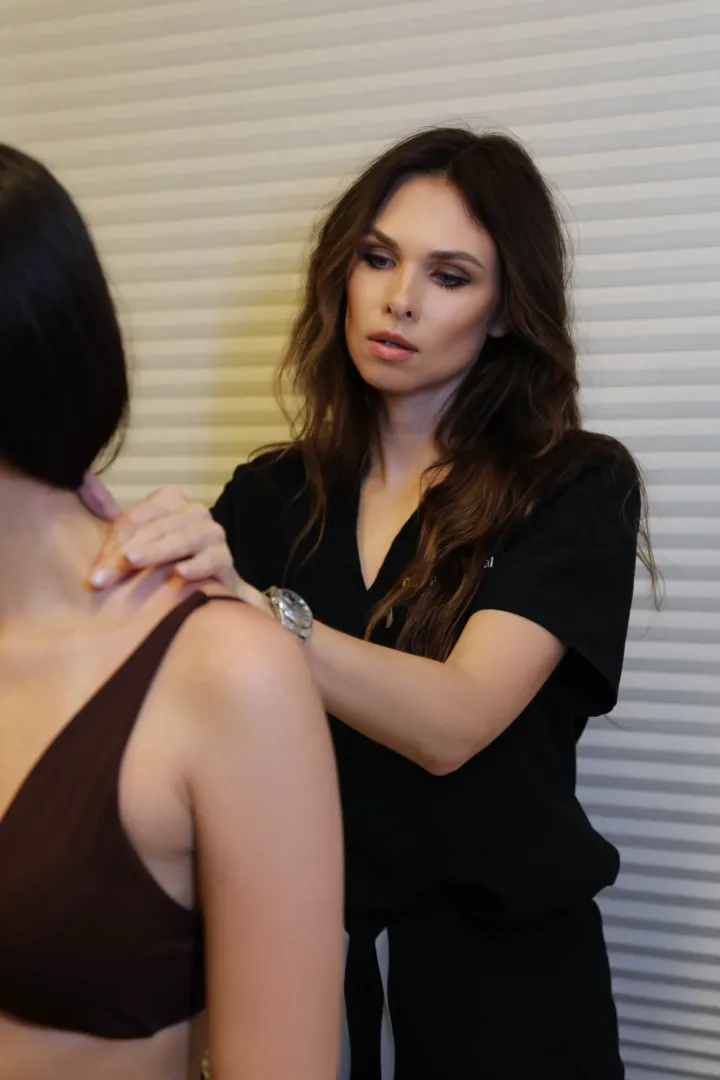
Our assessment follows five steps.
1
Posture and Movement Assessment
We examine shoulder positioning, shoulder blade movement, and the motions that reproduce symptoms.
2
Orthopedic Testing
We use orthopedic tests to evaluate possible involvement of the rotator cuff, shoulder joint, and other structures.
3
Manual Muscle Testing
We assess relevant muscles individually, including the supraspinatus, infraspinatus, subscapularis, and scapular stabilizers.
4
Individualized Needling
We select techniques according to the findings.
5
Reassessment
We repeat relevant muscle tests or shoulder movements to evaluate the immediate response.
Motor Point Acupuncture, Dry Needling, and Acupuncture: What’s the Difference?
Although all three techniques may use fine needles, they serve different treatment purposes.

Motor Point Acupuncture: Addressing Muscle Performance
A motor point is an anatomical region associated with a muscle’s motor nerve supply.
Motor point acupuncture involves stimulating selected points associated with the muscles we’re evaluating.
For example, if the supraspinatus demonstrates reduced strength during testing, we may use a motor point technique as part of the treatment.
We then repeat the relevant test to see whether performance has changed.
Sometimes we observe an immediate improvement in the patient’s ability to resist pressure or perform a movement.
Our goal is to address muscle performance as well as pain.
Dry Needling: Addressing Tight, Tender Muscles
Dry needling is commonly used to treat muscular trigger points.
These are localized areas of tenderness or sensitivity that may contribute to discomfort or restricted movement.
For example, a patient may demonstrate reduced external rotation strength while also experiencing tenderness in surrounding shoulder muscles.
When both findings are present, we may use motor point acupuncture and dry needling for different treatment objectives.
Acupuncture: Supporting Pain Relief
Acupuncture may also be used to influence pain-processing pathways within the nervous system.
We sometimes use distal acupuncture points, meaning needles are placed away from the shoulder.
These points may be selected as part of a broader pain-management approach.
By combining techniques, we can address different findings identified during the examination.
Can Acupuncture Help Rotator Cuff Pain?
Yes. Clinical research supports acupuncture as a treatment option for certain rotator cuff-related shoulder conditions.
A 2024 meta-analysis examining 13 randomized clinical trials involving 1,371 patients found that acupuncture, used alone or alongside physical therapy, improved shoulder pain and function over short- and medium-term follow-up periods.
Researchers also reported improvements in shoulder movements, including abduction, external rotation, and forward flexion.
These findings are especially relevant for people experiencing pain when lifting their arm sideways or reaching overhead.
The research supports acupuncture as a treatment option, although results vary depending on the specific shoulder condition and the treatment provided.
Can Sports Acupuncture Help Before Physical Therapy?
Sports acupuncture can be a useful complementary treatment option for some patients beginning rehabilitation.
For example, a patient may have difficulty performing a shoulder exercise because the movement is painful.
Acupuncture may help manage pain, potentially making it easier to participate in rehabilitation.
Motor point techniques may also be incorporated when our assessment identifies relevant muscle-performance findings.
Physical therapy remains important for progressively strengthening muscles and restoring function.
We view these approaches as potentially complementary rather than competing treatments.
What If My MRI Doesn’t Show Anything Wrong?
An MRI can reveal structural findings such as tendon tears, but it doesn’t directly measure how effectively a muscle performs during a manual muscle test.
That’s why clinical examination matters.
Some patients experience shoulder pain despite imaging that doesn’t identify a major structural abnormality.
We assess the shoulder’s strength, movement, and symptom response to help identify findings that may guide treatment.
Can Sports Acupuncture Help After Rotator Cuff Surgery?
Yes, sports acupuncture may be considered as a complementary treatment after rotator cuff surgery once the surgeon has cleared the patient for appropriate care.
Surgery repairs damaged tissue, but recovery also involves restoring strength, mobility, and coordinated shoulder movement.
This is where postoperative rehabilitation becomes essential.
Our assessment-based approach may complement that process by addressing pain and relevant muscular findings.
For example, once healing precautions permit, we may evaluate how the rotator cuff and surrounding muscles perform during selected movements.
Treatment must respect the surgical repair, healing stage, and surgeon’s rehabilitation protocol.
Why Choose Sports Acupuncture for Shoulder Pain?
We don’t use the same treatment for every painful shoulder.
We examine the muscles responsible for moving and stabilizing the joint, assess their performance, and select needling techniques based on the findings.
Our approach is particularly relevant to patients interested in understanding how muscle function may relate to their symptoms.
Whether you’re dealing with pain during overhead movement, rotator cuff irritation, or persistent discomfort after an injury, we look beyond the painful area.
What to Expect
01
Assessment
A detailed look at how your body moves, identifying restrictions, imbalances, and overload.
02
Understanding the Cause
We connect your symptoms to how your body is functioning – not just where it hurts.
03
Targeted Treatment
A combination of acupuncture, dry needling, and motor point work based on your needs.
04
Ongoing Progress
Treatment evolves as your body adapts, focusing on long-term results and better movement.
Shoulder Pain Treatment on Chicago’s North Shore

Sports Acupuncturist provides assessment-based acupuncture care for shoulder pain and rotator cuff complaints throughout Chicago’s North Shore.
We serve patients from Northbrook, Bannockburn, Deerfield, Highland Park, Glenview, Northfield, and surrounding communities.
Our Address
Sports Acupuncturist1535 Lake Cook Rd, Suite 405
Northbrook, IL 60062
Hours
By appointment only
Ready to find out what’s contributing to your shoulder pain?
Schedule an appointment for an individualized musculoskeletal assessment and treatment plan.
Initial Consultation + Treatment
45-60 minutes
A comprehensive evaluation, movement assessment, and your first treatment.
1535 Lake Cook Rd, Suite 405
Northbrook, IL 60062
By appointment only
Frequently Asked Questions
Why does my shoulder hurt when I lift my arm sideways?
The supraspinatus is one of the muscles involved in raising your arm, and pain during this movement can be associated with rotator cuff conditions. Other structures can produce similar symptoms, which is why orthopedic testing is important.
Can weak rotator cuff muscles contribute to shoulder pain?
Yes. Reduced strength or altered muscle coordination can be relevant to shoulder symptoms. We assess individual rotator cuff muscles and their role in shoulder movement to help guide treatment.
Can sports acupuncture help rotator cuff pain?
Yes. Research supports acupuncture as a treatment option for certain rotator cuff-related conditions. A 2024 meta-analysis involving 1,371 patients reported improvements in pain, function, and selected shoulder movements.
Can sports acupuncture help after shoulder surgery?
Yes, once cleared by the surgeon. It may complement postoperative rehabilitation by helping manage pain and addressing relevant muscular findings. Progressive rehabilitation remains essential for restoring strength and function.
Is motor point acupuncture different from dry needling?
Yes, in treatment objective and anatomical targeting. Motor point acupuncture targets selected regions associated with a muscle’s motor nerve supply. Trigger point dry needling targets areas of muscular tenderness or sensitivity. The techniques can overlap anatomically, but we use them for different clinical purposes.
Research References
- 2024 systematic review and meta-analysis of acupuncture for rotator cuff diseases. Included 13 randomized clinical trials involving 1,371 patients and reported improvements in shoulder pain and function.
- 2024 systematic review of acupuncture for shoulder impingement syndrome. Evaluated randomized trials reporting improvements in pain and shoulder function, while noting limitations in evidence quality.

About the Author
Dr. Lijana Shestopal, DTCM, L.Ac.
Dr. Lijana Shestopal is an Illinois-licensed acupuncturist specializing in sports acupuncture, orthopedic conditions, and musculoskeletal pain.
She earned her Master’s degree in Acupuncture and Herbal Medicine from the Midwest College of Oriental Medicine and subsequently completed her Doctor of Traditional Chinese Medicine (DTCM) degree at Five Branches University.
In addition to her formal education, Dr. Shestopal has completed extensive advanced training in orthopedic and sports acupuncture, with a particular focus on musculoskeletal assessment, manual muscle testing, motor point acupuncture, and dry needling.
She holds national board certification as a Diplomate of Acupuncture and Herbal Medicine through the National Certification Board for Acupuncture and Herbal Medicine (NCBAHM).
Her clinical approach combines traditional acupuncture with modern anatomical and orthopedic assessment techniques to address pain, muscle dysfunction, and movement-related conditions.
At Sports Acupuncturist, she focuses on identifying potential contributors to musculoskeletal pain rather than treating symptoms in isolation, using individualized treatment strategies to help patients improve function and return to their activities.