

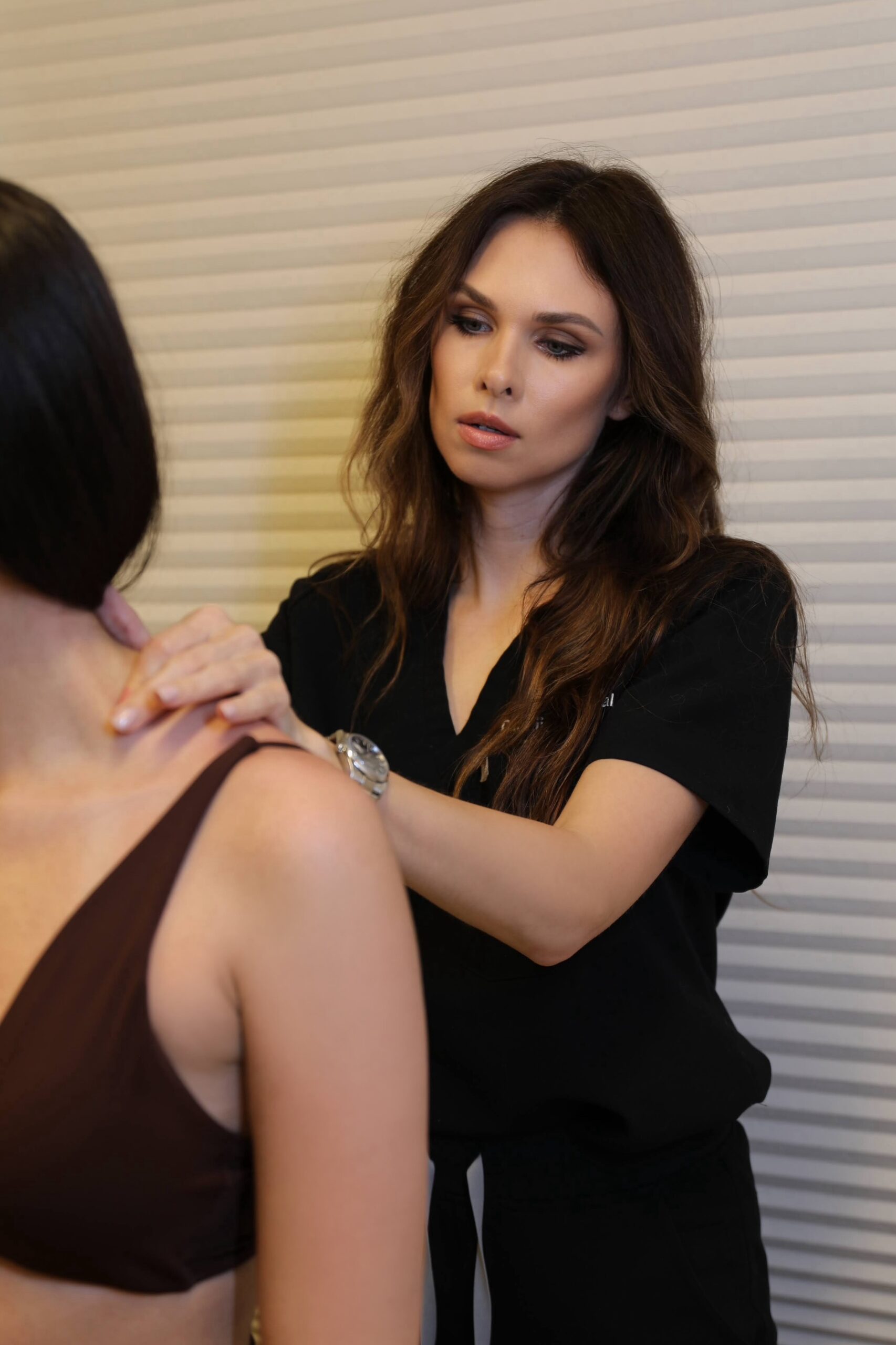
No injury. No clean diagnosis. Just a body quietly breaking down — and sending signals you have been calling ‘tension’ for years.
QUICK ANSWER Chronic neck pain, back pain, and tight shoulders without injury are almost always the result of postural muscle dysfunction. Postural muscles — designed to hold you upright — become chronically overloaded and tight. Phasic muscles — designed for movement and power — go quiet and stop firing. When these two systems fall out of balance, structures like the rotator cuff, lumbar spine, and cervical joints absorb loads they were never designed to handle. The result is persistent pain with a clean MRI. Sports acupuncture addresses this by targeting the root neuromuscular cause, not just the symptomatic site.
The Problem Nobody Is Diagnosing
Every week, patients arrive at sports acupuncture clinics with the same story. Shoulder pain after workouts. Low back that seizes up every morning. Neck pain that has not gone away in months. The imaging is clean. The orthopaedic says nothing is structurally wrong. The GP suggests anti-inflammatories and rest.
The pain keeps coming back.
This is not a mystery. It is a predictable mechanical outcome — one that standard medical imaging is simply not designed to detect, because it is a functional problem, not a structural one.
The root cause in the vast majority of these cases: a breakdown in the relationship between postural and phasic muscles, driven by the positions modern life forces your body to hold for hours every day.
Understanding this system is the first step toward breaking the cycle. Sports acupuncture, when applied with an understanding of this neuromuscular dysfunction, is one of the most effective tools available for resetting it.
What Are Postural and Phasic Muscles — and Why Do They Cause Pain?
| QUICK ANSWER Postural muscles are slow-twitch, endurance-based muscles designed to fire continuously and hold the skeleton upright. Phasic muscles are fast-twitch, power-based muscles designed to fire on demand for movement and force production, then rest. Neck pain, back pain, and tight shoulders typically begin when phasic muscles disengage and postural muscles become chronically overloaded. |
Postural muscles: the always-on system
| DEFINITION Postural muscles are slow-twitch muscle fibres designed for sustained, low-intensity contraction against gravity. They maintain joint position and spinal alignment continuously. Under chronic overload or sustained shortening, they tighten, shorten, and lose the ability to fully relax. |
Postural muscles are built for endurance. They were never designed to rest — they are the background hum of your musculoskeletal system, keeping you upright against gravity every waking moment. In a healthy body under normal movement demands, this works perfectly.
Under modern postural stress — prolonged sitting, forward head carriage, rounded shoulders — postural muscles are held in shortened or overstretched positions for hours at a time. They adapt. They tighten, shorten, and begin to send a low-level pain signal that you interpret as ‘tightness’ or ‘tension.’
Key postural muscles that commonly become overloaded:
- Hip flexors (psoas, iliacus, rectus femoris)
- Pec minor (anterior chest — pulls the shoulder forward)
- Upper trapezius (neck and upper shoulder — a primary driver of neck pain and tight shoulders)
- Lumbar erector spinae (lower back extensors — a primary driver of back pain)
- Sternocleidomastoid (neck — implicated in forward head posture and cervicogenic headache)
Phasic muscles: the on-demand power system
| DEFINITION Phasic muscles are fast-twitch muscle fibres designed for explosive or sustained force production during movement. They fire when recruited, then rest. Under chronic postural dysfunction, they receive reduced neurological input, progressively disengage, and can essentially switch off — a phenomenon called arthrogenic muscle inhibition. |
Phasic muscles are where power lives. They are designed to fire hard when you need them — for a sprint, a throw, a heavy lift — and then recover. Unlike postural muscles, they are not meant to be continuously active.
When posture deteriorates chronically, phasic muscles stop receiving the correct neural signals. They do not tighten like postural muscles — they weaken and disengage. The nervous system downregulates their activation in response to altered joint position, which is why they cannot simply be ‘switched back on’ with generic strengthening exercises.
Key phasic muscles that commonly disengage:
- Gluteus maximus and medius (primary hip extensors and pelvic stabilisers)
- Rhomboids and middle/lower trapezius (scapular retractors — when these go offline, tight shoulders follow)
- Serratus anterior (scapular upward rotation)
- Deep neck flexors — longus colli and longus capitis (cervical stabilisers — their absence drives neck pain)
- Vastus medialis oblique (VMO — medial knee stabiliser)
| KEY CLINICAL INSIGHT In a healthy body, postural and phasic muscles check and balance each other. When this system breaks down, the body does not simply hurt — it redistributes load to structures (tendons, capsules, joints, discs) not designed to carry it. That redistribution is what eventually shows up as neck pain, back pain, tight shoulders, and rotator cuff problems. |
Why Do Tight Shoulders and Upper Back Pain Keep Coming Back?
| QUICK ANSWER Prolonged sitting and forward head posture cause the pec minor to shorten and chronically pull the scapula forward. This forces the rhomboids — a phasic muscle built for bursts of effort, not sustained work — to fire continuously against that pull. The rhomboid cannot sustain that demand. It fatigues, overloads, and generates the persistent aching between the shoulder blades that most people call tight shoulders or upper back tension. |
The rhomboid minor is a small muscle sitting between your shoulder blades. Its job is scapular retraction — pulling the shoulder blade inward and back. It is a phasic muscle: built to fire, do its job, and rest.
Here is what prolonged desk posture does to that system.
Your shoulders round forward. Your pec minor — a postural muscle running from your ribs to your coracoid process — goes into chronic contraction, dragging your scapula into protraction. Your shoulders now spend six, eight, ten hours a day pulled out of neutral position.
The rhomboid has to fight that pull continuously — a job it was never designed for. Over weeks and months, it fatigues. It generates a continuous low-grade pain signal. You describe it as tight shoulders or tension between the shoulder blades. You stretch it. It comes back tomorrow.
| WHY STRETCHING ALONE DOES NOT FIX TIGHT SHOULDERS A chronically overworked muscle does not need more stretching. It needs the source of its overload — the tight anterior chain pulling it off-course — to be addressed. Stretching the rhomboid without releasing the pec minor and reactivating the lower trapezius is symptomatic management, not resolution. This is why the same tight shoulder comes back every single day despite stretching. |
This is where sports acupuncture becomes clinically significant. Dry needling applied to the hypertonic pec minor, upper trapezius, and anterior shoulder musculature reduces the neurological drive to those overactive muscles — allowing the scapula to return toward neutral and reducing the compensatory load on the rhomboids and the structures that create tight shoulders.
Combined with targeted phasic muscle reactivation (using motor point acupuncture) of the lower trapezius and rhomboids creates lasting functional change rather than temporary symptom relief.
How Does Poor Posture Lead to Neck Pain?
| QUICK ANSWER Forward head posture — where the head sits forward of the shoulders — increases the effective weight the cervical spine must support by approximately 10 lb for every inch of anterior translation. The deep neck flexors, which are phasic muscles designed to stabilise the cervical spine, progressively disengage. The cervical extensors and upper trapezius compensate, becoming chronically hypertonic. The result is persistent neck pain, cervicogenic headache, and upper shoulder tightness — all driven by posture, not by structural damage. |
The average human head weighs approximately 10–12 lb in neutral position. For every inch it translates forward — which is standard in people who work at desks or look at phones for extended periods — the effective load on the cervical spine increases by roughly 10 lb. At a modest two inches of forward translation, the neck is managing an effective load of 30–32 lb for hours every day.
The muscles designed to handle cervical stability under this load are the deep neck flexors — longus colli and longus capitis. These are phasic muscles. Under chronic forward head posture, they disengage. The cervical extensors — postural muscles — compensate and become chronically overloaded.
The result is the classic neck pain pattern: stiffness on waking, pain that builds through a desk day, tenderness at the base of the skull, and often headaches that originate from the upper cervical joints. None of this requires a disc herniation or a structural lesion. All of it is driven by a postural pattern that can be directly addressed.
| SPORTS ACUPUNCTURE FOR NECK PAIN Dry needling of the cervical extensors, suboccipital muscles, and upper trapezius reduces the hypertonic drive maintaining forward head posture. Motor point needling of the deep neck flexors facilitates their reactivation. This combination — reduce the overactive posterior chain, reactivate the inhibited anterior stabilisers — produces faster and more durable resolution of postural neck pain than manual therapy or stretching alone. |
How Does Poor Posture Lead to Rotator Cuff Problems?
| QUICK ANSWER Chronic scapular protraction and downward rotation — caused by tight anterior muscles and inhibited scapular stabilisers — narrows the subacromial space. Every arm elevation then impinges the supraspinatus tendon against the acromion. Repeated thousands of times across months and years, this mechanism produces rotator cuff tendinopathy and eventually tearing — without any single traumatic event. |
Understanding the rotator cuff’s role
The rotator cuff — supraspinatus, infraspinatus, teres minor, and subscapularis — stabilises the glenohumeral joint during movement. Their job is to centre the humeral head in the glenoid socket throughout the shoulder’s range of motion. They are stabilisers, not primary movers.
They function correctly only when the scapula is correctly positioned. When the scapula is chronically protracted and downwardly rotated — as it is in most people with desk-based posture — the subacromial space narrows. Every arm elevation involves the supraspinatus tendon passing through a tighter gap.
The four stages from posture to rotator cuff injury
| Stage 1 | Postural breakdown (months to years)Pec minor and upper traps shorten. Rhomboids, lower traps, and serratus anterior disengage. The scapula lives in chronic protraction and downward rotation. The subacromial space narrows with every arm elevation. |
| Stage 2 | Mechanical impingement begins (ongoing)Every shoulder movement occurs with a compromised subacromial space. The supraspinatus tendon experiences repeated low-grade compression against the acromion. The body responds with localised inflammation — subacromial impingement syndrome. |
| Stage 3 | Symptomatic phase (progressive)Shoulder aching after overhead activity. Pain lying on the affected side at night. Catching or clicking with internal rotation. Weakness on resisted external rotation. A pattern that can present for months or years before imaging shows structural change. |
| Stage 4 | Structural failure (eventual if unaddressed)Partial or full-thickness rotator cuff tear — described as coming ‘out of nowhere.’ In reality, the endpoint of a years-long mechanical failure process that sports acupuncture and corrective movement can interrupt at any earlier stage. |
| CLINICAL NOTE Research published in the Journal of Shoulder and Elbow Surgery consistently identifies scapular dyskinesis — abnormal scapular movement patterns — as a primary contributing factor in rotator cuff pathology. Addressing the muscular cause of dyskinesis, not just the rotator cuff itself, is essential for lasting resolution. |
Why Does Sitting All Day Cause Back Pain?
| QUICK ANSWER Prolonged sitting shortens the hip flexors, which tilts the pelvis anteriorly and increases lumbar lordosis. This places the lumbar extensors under sustained load. Simultaneously, the glutes — the primary hip extensors and pelvic stabilisers — progressively inhibit and disengage. The lumbar spine absorbs load that the glutes were designed to handle. The result is chronic back pain with no structural cause visible on imaging. |
The hip flexors — particularly the psoas major, iliacus, and rectus femoris — are postural muscles designed to be mildly active during standing and walking. When you sit for extended periods, they shorten adaptively. They learn the sitting position and stay there.
A shortened hip flexor complex pulls the pelvis into anterior tilt, increasing lumbar lordosis and placing the lumbar erector spinae under sustained compressive load. These muscles become chronically hypertonic — a postural response to an unstable lumbar environment.
Meanwhile, the gluteus maximus stops being recruited appropriately. This is glute amnesia: a genuine neurological inhibition driven by the altered joint position of a tilted pelvis. Research has documented measurable reductions in gluteal EMG amplitude in individuals with anterior pelvic tilt.
The back pain you feel every morning is not your back being weak. It is your back doing the work your glutes were supposed to do — and paying the price.
When the glutes are inhibited, their load redistributes — to the lumbar extensors (causing back pain and fatigue), to the hamstrings (causing posterior thigh tightness), to the SI joint (causing sacroiliac irritation), and to the lumbar discs (contributing to asymmetric compression and long-term degeneration).
Sports acupuncture to the hip flexor complex — combined with glute activation work — directly interrupts this cycle. Needling the psoas and TFL reduces hypertonic drive. Needling the gluteal motor points facilitates reactivation of inhibited fibres. Movement exercises then reinforce the new recruitment pattern.
How Does Sports Acupuncture Treat Neck Pain, Back Pain, and Tight Shoulders?
| QUICK ANSWER Sports acupuncture combines traditional acupuncture, motor point acupuncture and dry needling with sports medicine assessment, and corrective movement principles. It is particularly effective for neck pain, back pain, and tight shoulders because it directly resets the neuromuscular tone of overactive postural muscles and facilitates reactivation of inhibited phasic muscles — addressing the root cause rather than the symptomatic site. |
Sports acupuncture incorporates a sports medicine diagnostic framework — postural assessment, movement screening, orthopaedic testing — to identify the specific muscles driving dysfunction before any needles are placed. Treatment targets two parallel aims:
1. Reducing overactive postural muscle tone
Dry needling of trigger points and motor points in the pec minor, upper trapezius, hip flexors, cervical extensors, and lumbar extensors produces a rapid reduction in resting muscle tone. This has been documented to reduce referred pain patterns, restore joint range of motion, and alter the neural drive to the muscle — effects that take weeks to achieve through stretching alone.
2. Facilitating phasic muscle reactivation
Needling of motor points in inhibited muscles — gluteus maximus, lower trapezius, serratus anterior, deep neck flexors — increases motor unit recruitment and improves the timing and amplitude of muscle activation. This neurological reset creates the conditions for corrective exercises to work in a way they often cannot when the muscle is neurologically inhibited.
The combination — reduce the overactive, reactivate the inhibited, reinforce with movement — is what distinguishes sports acupuncture from purely symptomatic treatments and gives it a durable effect on neck pain, back pain, and tight shoulders.
Summary: Why Neck Pain, Back Pain, and Tight Shoulders Keep Coming Back
Chronic pain without a structural diagnosis is not mysterious. It is a mechanical and neuromuscular problem with a clear, addressable cause.
- Postural muscles — hip flexors, pec minor, upper traps, cervical and lumbar extensors — become chronically overloaded and shortened by modern sitting posture.
- Phasic muscles — glutes, rhomboids, lower traps, deep neck flexors — receive reduced neural input and progressively disengage.
- The resulting imbalance forces load onto passive structures — tendons, joint capsules, discs — that are not designed to sustain it.
- Neck pain develops because the cervical stabilisers go offline and the extensors compensate. Back pain develops because the glutes stop working and the lumbar spine picks up the load. Tight shoulders develop because the anterior chain locks the scapula out of position.
- Sports acupuncture, combined with targeted corrective movement, directly addresses the neuromuscular root of this dysfunction — producing outcomes that symptomatic treatments alone cannot achieve.
Your daily ache is a conversation your body is trying to have with you. The only question is whether you are ready to understand what it is actually saying.
Frequently Asked Questions
What is the difference between postural muscles and phasic muscles?
Postural muscles are slow-twitch, endurance-based muscles designed to fire continuously and hold the body upright against gravity. They include the hip flexors, upper trapezius, and pec minor. Phasic muscles are fast-twitch, power-based muscles designed to fire on demand for movement, then rest. They include the glutes, rhomboids, lower trapezius, and deep neck flexors. In chronic postural dysfunction, postural muscles become overloaded and tight, while phasic muscles disengage and weaken. This imbalance is the primary driver of neck pain, back pain, and tight shoulders without injury.
Why do I have neck pain even though my MRI is normal?
A normal MRI does not rule out functional pain. Most scans assess for structural damage — disc herniations, fractures, nerve compression. They do not evaluate muscle recruitment patterns, cervical alignment, or the balance between the deep neck flexors and cervical extensors. Neck pain without structural findings is almost always driven by forward head posture: the deep neck flexors disengage, the cervical extensors and upper trapezius compensate and become chronically overloaded, and the result is persistent neck pain and stiffness that imaging cannot capture.
Why do I have shoulder pain and tight shoulders even though my MRI is normal?
A normal MRI does not rule out functional shoulder pain. Shoulder pain without structural findings is almost always caused by scapular dyskinesis: abnormal shoulder blade positioning driven by tight anterior muscles (pec minor, upper traps) and inhibited posterior stabilisers (rhomboids, lower traps, serratus anterior). The supraspinatus tendon becomes repeatedly impinged against the acromion with every arm elevation as a result, producing pain and the sensation of tight shoulders that imaging does not capture.
What causes lower back pain without a herniated disc or injury?
The most common cause of back pain without structural injury is hip flexor shortening combined with gluteal inhibition. Prolonged sitting shortens the hip flexors, pulling the pelvis into anterior tilt and increasing lumbar lordosis. The glutes progressively disengage. The lumbar extensors absorb the load the glutes were designed to carry, generating chronic muscular overload and persistent back pain. This pattern is called lower crossed syndrome and responds well to sports acupuncture combined with targeted glute reactivation and hip flexor release.
Can sports acupuncture fix neck pain, back pain, and tight shoulders?
Sports acupuncture is one of the most effective interventions for posture-driven neck pain, back pain, and tight shoulders because it addresses both sides of the dysfunction simultaneously: it reduces the neuromuscular tone of overactive postural muscles through dry needling, and facilitates reactivation of inhibited phasic muscles through motor point stimulation. This combination allows the body to return to balanced joint loading — something stretching or exercise alone often cannot achieve when the underlying neuromuscular inhibition remains unaddressed.
How long does it take to fix neck pain and back pain with sports acupuncture?
Timeline varies based on chronicity, individual response, and consistency. Most patients with posture-driven neck pain or back pain begin to notice meaningful change within 4–6 sports acupuncture sessions combined with home exercise. Full resolution of a pattern established over years typically requires 8–16 weeks of consistent treatment and corrective movement work. Patients who address only one component — acupuncture without movement, or exercise without addressing neuromuscular inhibition — typically see slower and less durable results.
Is rotator cuff pain always caused by a tear?
No. The majority of rotator cuff pain does not involve a structural tear. The most common diagnosis is rotator cuff tendinopathy or subacromial impingement syndrome — both driven by repeated mechanical impingement of the supraspinatus tendon caused by poor scapular position, not by a discrete traumatic event. This is why tight shoulders and postural correction are central to rotator cuff rehabilitation, not just rotator cuff strengthening exercises.
What muscles should I target to relieve tight shoulders?
To relieve tight shoulders, you need to both release and reactivate. The pec minor, upper trapezius, and anterior deltoid are typically overactive and need to be lengthened and de-toned — sports acupuncture dry needling does this rapidly. The rhomboids, lower trapezius, and serratus anterior are typically inhibited and need to be reactivated through targeted exercises such as band pull-aparts, wall angels, and prone Y-T-W. Tight shoulders caused by this imbalance will not resolve from stretching alone.
What is glute amnesia and is it a real condition?
Glute amnesia is a colloquial term for gluteal inhibition — a documented neurological phenomenon in which the gluteus maximus and medius receive reduced motor drive and demonstrate lower EMG amplitude during functional movements. It is a consequence of prolonged sitting, anterior pelvic tilt, and hip flexor shortening. It is clinically significant because the load the glutes fail to absorb redistributes to the lumbar spine, hamstrings, and SI joint — and is a primary driver of back pain in desk-based populations.
Terms used in this article, defined for clarity.
Anterior pelvic tilt: Forward rotation of the pelvis, causing increased lumbar lordosis. Common consequence of shortened hip flexors from prolonged sitting. A primary driver of back pain.
Arthrogenic muscle inhibition: Neurological reduction in motor drive to a muscle caused by altered joint position or joint pathology. Key mechanism behind phasic muscle disengagement in postural dysfunction.
Dry needling: Insertion of a fine filiform needle into a muscle trigger point or motor point to reduce tone or facilitate motor recruitment. A core technique in sports acupuncture.
Glute amnesia: Colloquial term for gluteal inhibition — reduced neural recruitment of the glutes due to prolonged sitting and anterior pelvic tilt. Leads to lumbar and SI joint overload and is a primary cause of back pain.
Lower crossed syndrome: A pattern of muscle imbalance described by Vladimir Janda involving tight hip flexors and lumbar extensors combined with inhibited glutes and deep abdominals. A primary driver of chronic back pain.
Motor point: The point on a muscle surface where a nerve enters the muscle belly — the site of highest electrical excitability. Needling motor points produces the strongest neuromuscular response.
Phasic muscle: A fast-twitch, movement-oriented muscle designed for on-demand force production and rest. Disengages under chronic postural dysfunction, contributing to neck pain, back pain, and tight shoulders.
Postural muscle: A slow-twitch, endurance-oriented muscle designed to fire continuously against gravity. Becomes overloaded and hypertonic under chronic postural stress.
Scapular dyskinesis: Abnormal positioning or movement of the scapula during arm elevation. A primary contributing factor in rotator cuff impingement, shoulder pain, and tight shoulders.
Subacromial impingement: Compression of the supraspinatus tendon against the acromion during shoulder elevation — caused by narrowing of the subacromial space, often secondary to scapular dyskinesis.
Trigger point: A hyperirritable spot in a skeletal muscle associated with a palpable nodule in a taut band of muscle fibre, producing referred pain when stimulated. Targeted in sports acupuncture dry needling.

Leave a Reply Cancel reply
book
privacy policy
Contact us
press & media
faqs
About us
Services
Home
Get expert tips, recovery insights, and holistic health updates - straight to your inbox. Subscribe to our newsletter for practical advice, clinic news, and exclusive offers designed to support your movement and well-being.
Stay up to date
At Sports Acupuncturist, we’re dedicated to supporting your recovery, performance, and long-term health. Through personalized care and evidence-based techniques, we help you move better, feel stronger, and stay injury-free. Let’s move forward - together.
Share Your Perspective