Knee Pain and Runner’s Knee Treatment in Northbrook, IL

Does your knee hurt when going up or down stairs, running, squatting or standing up after sitting for a long time? Do you experience pain around your kneecap, tightness in your thighs or recurring knee discomfort that interferes with exercise?
While knee pain is often blamed on the knee itself, the problem may also involve how your hips, ankles and surrounding muscles function.
The knee sits between two highly mobile joints—the hip and the ankle. When either of these areas is not moving or functioning effectively, the knee may experience additional stress.
At Sports Acupuncturist in Northbrook, Illinois, we combine orthopedic testing, manual muscle testing, movement assessment, motor point acupuncture and trigger point dry needling to address knee pain and its potentially contributing factors.
Where you feel your knee pain is not necessarily where the problem begins.
Common Knee Pain Symptoms and Conditions We Address
- Runner’s knee (patellofemoral pain syndrome)
- Pain around or behind the kneecap
- Pain below the kneecap
- Jumper’s knee (patellar tendinopathy)
- Knee pain when going up or down stairs
- Knee pain when squatting or lunging
- Knee pain after running
- Pain on the outside of the knee
- IT band syndrome
- Knee stiffness after prolonged sitting
- Knee osteoarthritis
- Quadriceps and hamstring-related knee pain
- Overuse and sports-related knee injuries
What Is Runner’s Knee?
Runner’s knee, medically known as patellofemoral pain syndrome, describes pain around or behind the kneecap.
Despite its name, runner’s knee is not limited to runners. It can affect weightlifters, cyclists, hikers, dancers and individuals who spend considerable time sitting.
Common symptoms include:
- Pain when going down stairs
- Discomfort during squats and lunges
- Pain during or after running
- Aching around or behind the kneecap
- Knee discomfort after sitting with bent knees for an extended period
- Pain during activities that repeatedly load the knee
Runner’s knee can develop when the demands placed on the kneecap and surrounding structures exceed their ability to tolerate those demands.
Changes in training intensity, muscular function, strength, movement patterns and recovery can all play a role.
What Does the Location of Your Knee Pain Tell You?
Different areas of knee pain may indicate different structures involved in your symptoms.
| Location of Pain | Possible Contributing Conditions |
|---|---|
| Around or behind the kneecap | Runner’s knee or patellofemoral pain syndrome |
| Directly below the kneecap | Patellar tendinopathy or jumper’s knee |
| Above the kneecap | Quadriceps tendon irritation |
| Outside of the knee | IT band syndrome or other lateral knee structures |
| Inside of the knee | Meniscus, ligament or tendon-related irritation |
| Behind the knee | Hamstring-related discomfort, joint swelling or a Baker’s cyst |
| Throughout the knee | Osteoarthritis or other joint-related conditions |
Pain location provides valuable information, but it does not always reveal why the affected area is becoming irritated.
Orthopedic testing and movement assessment help determine which structures may be involved and whether further medical evaluation is necessary.
Why Your Knee Pain May Actually Start at Your Hip
The muscles surrounding your hips help control the position and movement of your thigh bone.
Two particularly important muscles are the gluteus maximus and gluteus medius.
The gluteus maximus, your largest glute muscle, contributes to powerful movements such as running, climbing stairs and standing up from a squat.
The gluteus medius, located on the side of your hip, helps stabilize your pelvis and control your leg when standing on one foot.
Every time you take a step while walking or running, your body briefly relies on one leg for support.
If the hip muscles are not providing adequate control, the thigh may rotate inward and the knee may move toward the center of the body.
This movement pattern is commonly called dynamic knee valgus, or inward knee collapse.
You may notice it when:
- Squatting
- Performing lunges
- Running
- Walking downstairs
- Landing from a jump
- Standing on one leg
When repeated under load, this movement pattern may contribute to excessive stress on certain knee structures in some individuals.
However, inward knee movement alone does not automatically indicate a problem. Its significance depends on muscle function, movement control, symptoms and activity demands.
This is why assessing the hips is an important part of evaluating knee pain.
How Your Feet and Ankles Can Contribute to Knee Pain
Just as the hips influence the knee from above, the feet and ankles influence it from below.
For example, if your ankle does not bend forward sufficiently during a squat, your body may compensate by changing the position of your foot, knee or hip.
Similarly, excessive inward rolling of the foot during movement may influence how the lower leg rotates and how forces are distributed through the knee.
Potential contributing factors include:
- Restricted ankle mobility
- Reduced calf muscle function
- Altered foot mechanics
- Reduced foot stability
- Previous ankle injuries
- Sudden changes in running footwear or activity levels
Having flat feet or limited ankle mobility does not automatically mean you will develop knee pain.
The important question is whether these factors are affecting how you move and contributing to your particular symptoms.
Why Tight Quadriceps May Not Be the Real Problem
The quadriceps are the large muscles at the front of your thigh. They straighten the knee and help control movements such as walking downstairs, running, jumping and squatting.
Patients with knee pain frequently complain of tight quadriceps.
However, a muscle that feels tight is not necessarily physically shortened.
Your quadriceps may feel tight because they are:
- Overworked
- Fatigued
- Compensating for other muscles
- Recovering from excessive training demands
- Experiencing pain-related tension
- Genuinely restricted in flexibility
For example, if your glutes are not contributing effectively during a squat, your quadriceps may have to take on more of the workload.
Repeatedly stretching, massaging or dry needling the quadriceps may provide temporary relief, but the same tension may return if the contributing movement pattern remains unchanged.
The opposite can also happen. Knee pain itself can interfere with the nervous system’s ability to fully activate the quadriceps, a phenomenon known as muscle inhibition.
In this situation, the muscle may require improved activation rather than additional relaxation.
The key is determining which muscles need to be released, which need to be activated and which need to be strengthened.
Runner’s Knee vs. Jumper’s Knee vs. IT Band Syndrome
These are three common overuse conditions that can produce knee pain, particularly among active individuals.
| Condition | Typical Symptoms |
|---|---|
| Runner’s knee | Pain around or behind the kneecap, especially during squatting, running, stairs or prolonged sitting. |
| Jumper’s knee | Localized pain in the tendon directly below the kneecap, often aggravated by jumping, running or explosive movements. |
| IT band syndrome | Pain on the outside of the knee, frequently developing during repetitive activities such as running or cycling. |
Although these conditions can share contributing factors, they involve different structures and may require different treatment and rehabilitation strategies.
For example, jumper’s knee often requires carefully planned tendon-loading exercises, while runner’s knee rehabilitation commonly focuses on improving both hip and knee strength and managing activity demands.
Is Your Knee Pain a Mobility, Stability or Strength Problem?
When a movement becomes painful or restricted, many people assume they need to stretch more.
However, knee problems can also involve difficulty controlling movement.
| Type of Problem | What It Means for Your Knee |
|---|---|
| Mobility | Your hips, ankles or surrounding tissues may not have sufficient freedom of movement. |
| Stability | Your body may have difficulty maintaining control of the knee and surrounding joints under load. |
| Muscle activation | Certain muscles may not be contributing effectively when needed. |
| Strength and endurance | Your muscles may lack the capacity to tolerate repeated physical demands. |
For example, someone who struggles with a single-leg squat may not necessarily have tight muscles. They may have difficulty controlling their hip, knee and ankle together.
This distinction matters because stretching, muscle activation and strengthening serve different purposes.
An individualized assessment helps determine which approach may be appropriate.
How We Assess and Treat Knee Pain
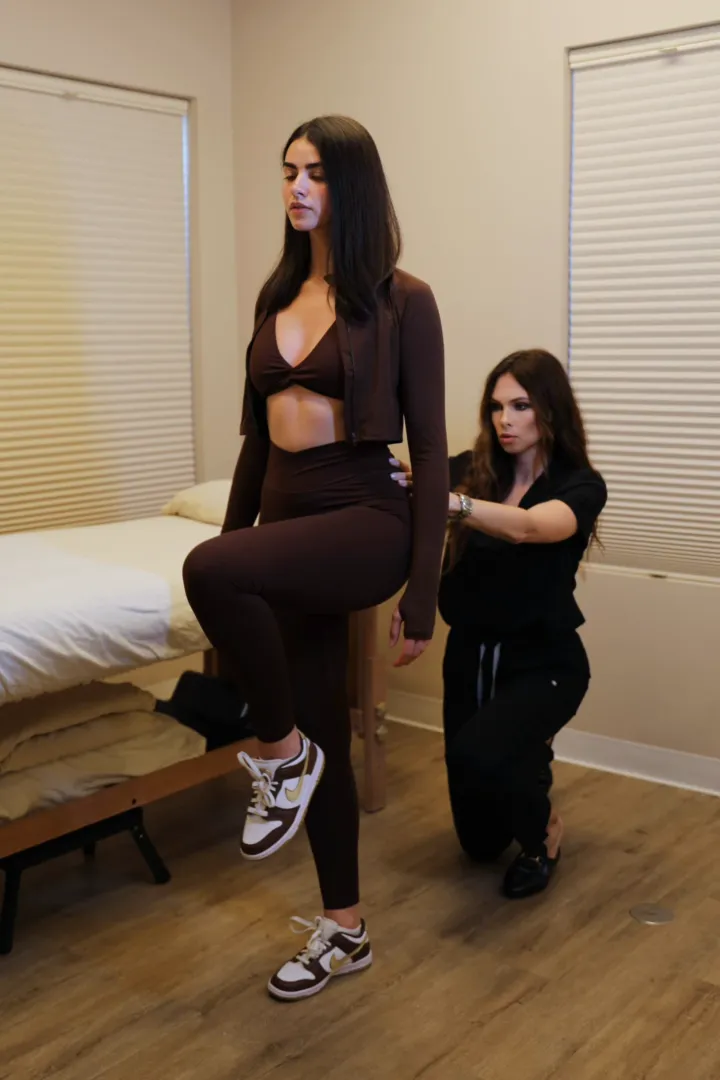
At Sports Acupuncturist, we look beyond the knee to evaluate how your entire lower body functions.
1
Orthopedic Testing
We perform specific physical tests to help determine whether your pain may involve muscles, tendons, ligaments, the meniscus or other structures within the knee.
This also helps identify situations that may require diagnostic imaging or additional medical evaluation.
2
Postural Assessment
We evaluate the positioning of your pelvis, hips, knees, ankles and feet.
The way these structures interact can influence how forces are distributed throughout your lower body.
3
Manual Muscle Testing
We test selected muscles to evaluate how effectively they produce and maintain force.
Depending on your symptoms, this may include testing the glutes, quadriceps, hamstrings, calf muscles and muscles supporting the hip and ankle.
This helps identify potentially underperforming muscles and compensatory patterns.
4
Functional Movement Assessment
We may assess movements such as squatting, bending, standing on one leg or stepping down.
These movements help us observe how your muscles and joints work together during activities that may reproduce your symptoms.
5
Individualized Treatment and Reassessment
Based on our findings, we select the appropriate needling techniques.
Following treatment, relevant muscle tests and movements may be reassessed to evaluate your response and guide subsequent care.
How Sports Acupuncture Helps With Knee Pain
Sports acupuncture combines three complementary needling techniques.
| Treatment | What It May Help You Achieve |
|---|---|
| Motor point acupuncture | Improve the activation of muscles that may not be working effectively, including the glutes and quadriceps. |
| Trigger point dry needling | Reduce painful muscular tension, knots and areas of tenderness. |
| Acupuncture | Reduce pain, influence local circulation and help regulate pain signals within the nervous system. |
For a patient with runner’s knee, treatment may involve more than needling around the kneecap.
If muscle testing reveals reduced glute activation alongside excessive quadriceps tension, treatment may focus on improving glute recruitment while addressing discomfort in the quadriceps.
For another patient, restricted ankle mobility or localized tendon pain may require a different approach.
Two patients with the same diagnosis may have different contributing factors and therefore benefit from different treatment strategies.
Why Corrective Exercises Are Important for Knee Pain
Treatment may help reduce pain and improve muscular function, but long-term improvement often requires building the body’s ability to tolerate physical demands.
This is particularly important for runners and athletes who repeatedly load the same muscles, tendons and joints.
Depending on your assessment findings, corrective exercises and rehabilitation may focus on:
| Exercise Focus | Purpose |
|---|---|
| Glute strengthening | Improve hip stability and control of the thigh bone. |
| Quadriceps strengthening | Improve knee support and tolerance to activities such as stairs and squats. |
| Single-leg stability exercises | Improve coordination and control during walking, running and athletic activities. |
| Ankle mobility exercises | Improve ankle movement where restrictions are present. |
| Calf strengthening | Develop greater capacity to absorb and transfer forces during movement. |
| Progressive tendon-loading exercises | Improve tendon tolerance to physical activity over time. |
| Movement retraining | Address movement patterns that may be contributing to symptoms. |
Not every patient needs the same exercises.
Someone with runner’s knee may require a different rehabilitation program from someone with a patellar tendon injury or knee arthritis.
Sports acupuncture can complement physical therapy and exercise-based rehabilitation by addressing pain, muscular tension and altered muscle activation.
Why Runners Develop Recurring Knee Pain
Running is a repetitive activity that requires coordinated movement throughout the entire body.
Even small limitations in strength, mobility or movement control may become more noticeable when repeated over thousands of steps.
However, knee pain is not always caused by poor running technique. Sometimes, the body simply has not had enough time to adapt to an increase in physical demands.
Common contributing factors include:
- Increasing running distance too quickly
- Sudden increases in speed or intensity
- Introducing hills or downhill running
- Insufficient recovery between training sessions
- Reduced hip or knee muscle strength
- Restricted ankle mobility
- Previous injuries
- Sudden changes in footwear
- Inadequate strength training
For runners, the goal is not necessarily to stop running completely but to understand what is contributing to the pain and adjust training accordingly.
Appropriate treatment, gradual increases in training demands and targeted strengthening may help support a return to comfortable running.
Can Acupuncture Help With Knee Arthritis?
Knee osteoarthritis involves changes within the joint, including the cartilage and surrounding structures.
However, arthritis-related changes visible on an X-ray do not always correspond directly with the amount of pain a person experiences.
Muscular strength, joint mobility, inflammation, activity levels and nervous system sensitivity can also influence symptoms.
Acupuncture may help manage knee arthritis-related pain and improve physical function in some patients.
Motor point acupuncture may also be considered when assessment identifies reduced muscle activation, while dry needling may help address associated muscular discomfort.
Acupuncture does not regenerate lost cartilage or reverse osteoarthritis. Treatment focuses on pain management, muscular function and improving tolerance to everyday activities.
Appropriate strengthening exercises remain an important part of managing knee arthritis.
Does Acupuncture Really Work for Knee Pain?
Acupuncture has been extensively studied for chronic musculoskeletal pain, including knee osteoarthritis.
A large 2018 analysis involving more than 20,000 patients found that acupuncture provided greater benefits for the chronic pain conditions studied than sham acupuncture or no-acupuncture control treatments.
Research into dry needling has also demonstrated potential short-term benefits for some patients with patellofemoral pain, although findings vary depending on the condition and treatment approach.
Clinical guidelines for runner’s knee emphasize hip and knee strengthening, patient education and appropriate management of physical activity.
Individual components of sports acupuncture have been studied and demonstrated positive results in different areas of musculoskeletal care.
Combining these techniques with individualized assessment and appropriate rehabilitation allows treatment to address several factors potentially contributing to knee pain.
Sports Acupuncture vs. Physical Therapy, Chiropractic Care and Massage for Knee Pain
| Discipline | What It Can Help You Achieve |
|---|---|
| Sports acupuncture | Reduce pain and muscular tension while addressing altered muscle activation and muscular imbalances. |
| Physical therapy | Improve strength, joint mobility, stability, movement control and tolerance to physical activity. |
| Chiropractic care | Address certain joint-related movement restrictions and musculoskeletal discomfort. |
| Massage therapy | Reduce muscular tension and soft tissue discomfort. |
These approaches can complement one another.
For example, sports acupuncture may help address pain and reduced glute or quadriceps activation, while physical therapy helps build the strength and endurance needed for longer-term improvement.
What to Expect
01
Assessment
A detailed look at how your body moves, identifying restrictions, imbalances, and overload.
02
Understanding the Cause
We connect your symptoms to how your body is functioning – not just where it hurts.
03
Targeted Treatment
A combination of acupuncture, dry needling, and motor point work based on your needs.
04
Ongoing Progress
Treatment evolves as your body adapts, focusing on long-term results and better movement.
Knee Pain and Runner’s Knee Treatment in Northbrook, Illinois
At Sports Acupuncturist, Dr. Lijana Shestopal, DTCM, L.Ac., specializes in sports injuries, orthopedic conditions and musculoskeletal pain.
By combining orthopedic testing, manual muscle testing, postural and movement assessment, motor point acupuncture and trigger point dry needling, we take an individualized approach to understanding why your knee pain may have developed and why it may keep returning.
Whether you are a runner training for your next race, an athlete recovering from an injury or someone experiencing knee pain during everyday activities, treatment is tailored to your individual findings.
We serve Northbrook, Deerfield, Bannockburn, Highland Park, Lake Forest, Glenview and surrounding Chicago North Shore communities.
Initial Consultation + Treatment: 45–60 minutes
Our Address
Sports Acupuncturist1535 Lake Cook Rd, Suite 405
Northbrook, IL 60062
Hours
By appointment only
Your knee may be where you feel the pain, but it may not be where the problem begins.
Schedule your initial consultation and treatment today.
Initial Consultation + Treatment
45-60 minutes
A comprehensive evaluation, movement assessment, and your first treatment.
1535 Lake Cook Rd, Suite 405
Northbrook, IL 60062
By appointment only
Frequently Asked Questions About Knee Pain
Why does my knee hurt when going down stairs?
Walking downstairs requires your quadriceps to control the lowering of your body, increasing the demands on your knee and kneecap. Pain during this activity is common with runner’s knee, although other structures may also be involved.
Why does my knee hurt when squatting?
Squatting requires coordinated movement of the hips, knees and ankles. Pain may be associated with the kneecap, tendons, joint structures, muscular imbalances or difficulty tolerating the load placed on the knee.
Can weak glutes cause knee pain?
Reduced glute strength or poor muscle activation may influence how the thigh and knee move. In some individuals, this can contribute to altered loading of the knee during running, squatting and other activities.
Can tight quadriceps cause knee pain?
Excessive quadriceps tension may contribute to discomfort around the kneecap. However, it is important to determine whether the quadriceps are genuinely tight or simply overworked.
Can flat feet cause knee pain?
Foot mechanics can influence how the lower leg and knee move. However, having flat feet does not automatically cause knee pain. An individualized assessment can help determine whether foot mechanics are contributing to your symptoms.
Why does my knee hurt after sitting for a long time?
Prolonged sitting with bent knees can aggravate discomfort associated with runner’s knee. This is sometimes called the movie theater sign because symptoms occur after sitting for an extended period.
Is acupuncture or dry needling better for knee pain?
The most appropriate technique depends on what is contributing to your pain. Dry needling may help address painful muscular tension, motor point acupuncture may help improve muscle activation, and acupuncture may help manage pain.
Sports acupuncture combines these techniques when appropriate.
Can acupuncture help with runner’s knee?
Acupuncture and dry needling may help manage pain and associated muscular dysfunction. When combined with appropriate strengthening, movement rehabilitation and training adjustments, they may form part of a comprehensive treatment approach.
Should I stop running if I have runner’s knee?
Not necessarily. Some individuals benefit from temporarily reducing their running distance or intensity rather than stopping completely.
The appropriate decision depends on symptom severity, the underlying condition and how your knee responds to activity.
How many acupuncture treatments will I need for knee pain?
Treatment frequency depends on how long you have experienced pain, the structures involved, your activity level and your response to treatment.
Reassessment helps determine whether continued treatment is appropriate.
When should I be concerned about knee pain?
Seek prompt medical evaluation if you experience significant swelling, an inability to bear weight, knee locking, repeated giving way or severe pain following an injury.
A hot, red and swollen knee accompanied by fever requires urgent medical attention.
Sudden calf swelling or pain, particularly when accompanied by chest pain or shortness of breath, also requires urgent evaluation.
Scientific References
- Vickers AJ, et al. Acupuncture for Chronic Pain: Update of an Individual Patient Data Meta-Analysis. The Journal of Pain. 2018;19(5):455–474.
- Willy RW, et al. Patellofemoral Pain: Clinical Practice Guidelines. Journal of Orthopaedic & Sports Physical Therapy. 2019;49(9):CPG1–CPG95.
- Navarro-Santana MJ, et al. Effects of Trigger Point Dry Needling for the Management of Knee Pain Syndromes: A Systematic Review and Meta-Analysis. Journal of Clinical Medicine. 2020;9(7):2044.
- Neal BS, et al. Best Practice Guide for Patellofemoral Pain Based on Synthesis of a Systematic Review, the Patient Voice and Expert Clinical Reasoning. British Journal of Sports Medicine. 2024.
This information is intended for educational purposes and does not replace individualized medical evaluation.
Articles on this topic
Sports Injuries10 min read
How to Fix IT Band Tightness: Sports Acupuncture Treatment in Northbrook, IL
Find out ways to alleviate IT Band tightness for a healthier lifestyle, whether you are a runner or a desk worker.
Patient Guides16 min read
IT Band Syndrome: Causes, Symptoms & Treatment Guide
Get back to your favorite activities by addressing IT band syndrome. Discover effective strategies for relief and recovery today.
Recovery & Performance8 min read
Understanding Knee Pain: Common Causes and How Sports Acupuncture Provides Lasting Relief
Find out how to manage knee pain effectively. Explore treatment options that promote faster healing and recovery.